
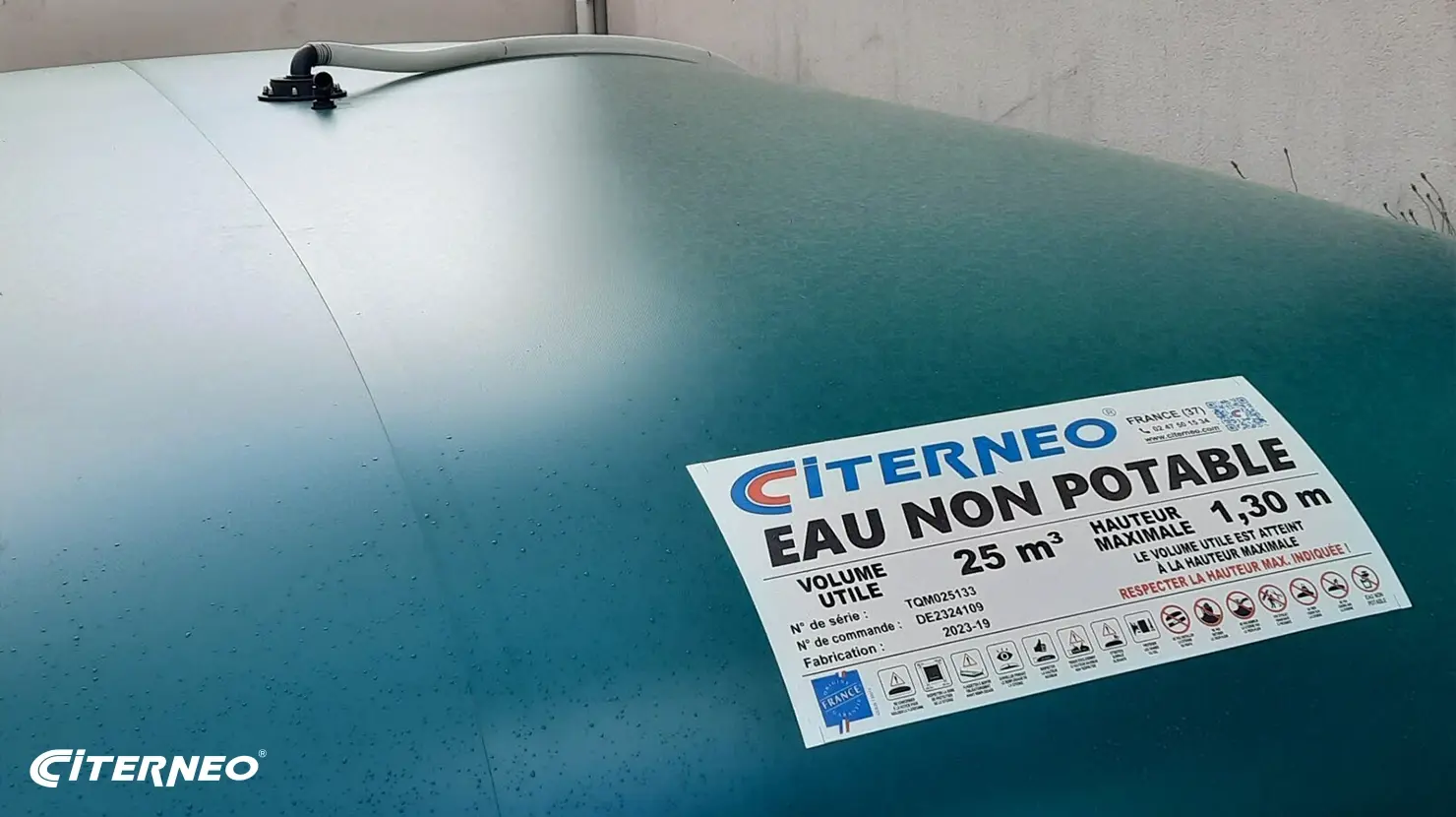
At Raon-aux-Bois, a small commune in the Vosges region, the municipality has just equipped itself with a flexible tank to recover rainwater. With a capacity of 25 m³, this water reclaimer is intended for watering the commune's green spaces.
Many French local authorities have already seized upon this emergency and are initiating steps to promote the preservation of this resource.
Access to the services of this vital resource, quantity and quality, protection of the aquatic environment, climate footprint... water is becoming the object of a symbolic and vital battle, as numerous studies predict a scarcity of fresh water in France and invite us to rethink its use.
But in concrete terms, how do we go about it? What approach should be favored?
What solutions have been put in place by local authorities?
At Raon-aux-Bois, the flexible tank is installed behind a technical room and will water the commune's green spaces for two months.
To save water, local authorities have no choice but to anticipate and act to :
improve network efficiency
reuse wastewater
store rainwater
recommend ecogestures to citizens and professionals
According to the Bureau de Recherches Géologiques et Minières (BRGM), two-thirds of water tables have been below normal levels since June 1, 2023.
Faced with this water shortage, départements and communities of communes are already implementing restrictions on water use.
At Citerneo, we've been at the side of these communities for 16 years, who have been thinking and acting for a long time to fight and preserve water resources.
Thanks to proven and affordable solutions, we are able to meet the challenges of drought and stormwater management during heavy rainfall.
We have drawn up a panorama of leading and inspiring actions that could simply be duplicated to save rainwater on a daily basis and recycle it.
Pool water to fight fires and water green spaces
Faced with drought, the Vienne département has declared a state of "crisis", leading the prefecture to take restrictive measures regarding water use.
In Châtellerault, the town council has found an innovative solution implemented as long as 16 years ago: the recovery of water from swimming pools.
When emptying the three pools at the Châtellerault aquatic center, the water is stored in initial tanks and then transferred to a second tank with a capacity of 55 m³, where the chlorine evaporates naturally, requiring no additional treatment. Once this process is complete, maintenance workers can easily pump this water for use in watering green spaces or for road cleaning. This operation is carried out all year round, not just during drought periods.
In the commune of Jaunay-Marigny, which is regularly confronted with early drought episodes, a 360 m³ Citerneo flexible tank has been installed in the grounds of the municipal swimming pool. Supplied and installed by our local distributor, it stores the pool's winter water for later reuse.

Another flexible tank is being installed at the municipal technical center to collect rainwater from rooftops!
In Palavas-les-Flots, the large pool has just been emptied of its 500 cubic meters. On June 26, 2023, the SDIS de l'Hérault came to recover the water drained from the municipal pools to supply its reserves and anticipate firefighting. Chlorine generally takes between a week and ten days to evaporate naturally.
In Grenoble this time, last summer the city decided on an operation to reuse water from the Jean Bron public swimming pool.
2,750 m³ of water were used to clean the roads and water green spaces.
This action could be continued this year. Usually, the water from the pools goes back into the wastewater treatment circuit, when the water is renewed.
The Nakache pool in Toulouse has the largest outdoor pool in Europe, at 150 meters long and 50 wide.
When it is emptied each year, the city decided in 2022, for the first time, to recover the water to water its green spaces and fill the fountains.
"Before, we simply emptied it," admits Jean-Luc Moudenc, the mayor of Toulouse, "but after what we've been through, it leads us to ask questions we weren't asking ourselves.
Rainwater integrated into a necessary environmental reflection
Other communities have made other choices, as water is indeed at the heart of current climate concerns.
The village of Lhomme, in the Sarthe region of France, recently installed a flexible Citerneo rainwater harvesting tank, resulting in substantial water savings.
With a capacity of 30,000 m³, this tank is equivalent to two months' watering requirements in the commune. This civic and environmental initiative is an inspiring way to rethink our water consumption.
The commune of Belley in the Ain region of France has opted, for a flexible tank to responsibly manage water in times of drought.
It has invested in a 70 m³ flexible tank to store rainwater to then water green spaces, even in times of restriction.
At the same time, this municipality has diversified its plantings, selecting less water-hungry and more resistant varieties to reduce its water consumption.
Trees, micro-forests and flowers also play a key role in this transition to sustainable water management, and the Belley municipality has understood this well.
The commune of Marnay now has a new tank with a storage capacity of 20,000 liters for the recovery of rainwater from the municipal workshops.
This water is used by municipal agents for watering plants and trees, as well as filling the tank of the street sweeper.
Costing 1,500 euros, this investment is part of the municipality's eco-responsible approach, aimed at enhancing natural resources and adopting sustainable practices.
Wastewater reclamation part of an eco-citizen approach by municipalities
To limit water wastage, the Frenzy Waterpark near Perpignan, has made another choice but one with the same philosophy: to recycle this vital resource.
This leisure park has invested in an innovative system for recovering wastewater when washing its filters.
The water is thus stored in a 120 m³ Citerneo flexible tank. The aim is for firefighters to come and help themselves if necessary to fill their trucks. The city's technical services are also invited to use it to clean the streets and water the green spaces.
By reducing dependence on groundwater, sustainable water management thus becomes possible while ensuring essential citizen production.
The Vendée Eau syndicate has decided to treat its wastewater to make it fit for consumption.
It has installed a refining unit at the outlet of the treatment plant and sent this water to the reservoir that supplies the drinking water plant.
This project, named the "Jourdain" Program, borrowed from the name of a Middle Eastern river, represents a unique initiative in Europe.Its aim: to redirect treated water to the Jaunay reservoir, so that it can once again be captured by the drinking water production plant and distributed to the domestic network.
"This closed-circuit system is of crucial importance for the future of the department," stresses Vendée Eau president Yannick Moreau, the chairman of the Sabl agglomeration.
All these investments have a real sustainable impact.
Some examples of water conservation and storage, outside France, in Europe
While French local authorities don't hesitate to set an example, there are also numerous cases in Europe.
One of our customers in Spain uses water reclaimers to maintain private swimming pools. When the pool is cleaned, the water is stored in a flexible tank before being reused to refill it and put it back into service.
By temporarily storing water, these tanks help save this resource.
Also this year, the Prague Festival called on Citerneo to store drinking water, as well as effluent following the installation of mobile sanitary facilities.
A 20m³ flexible tank for drinking water, as well as three tanks for wastewater storage were installed on site.
All these examples demonstrate the usefulness of storing water and highlight the contribution of territories in adapting to a dried-up future.
Conclusion
At Citerneo, we know, It's essential to anticipate water needs by simply storing rainwater and swimming pool water, so that it can be used during tighter periods.
All our flexible tanks are practical and easy to transport when empty, and enable permanent or temporary storage of liquids.
Economical, practical and very easy to install, they can be used by a wide variety of audiences: local authorities, industrialists, farmers or even private individuals.