
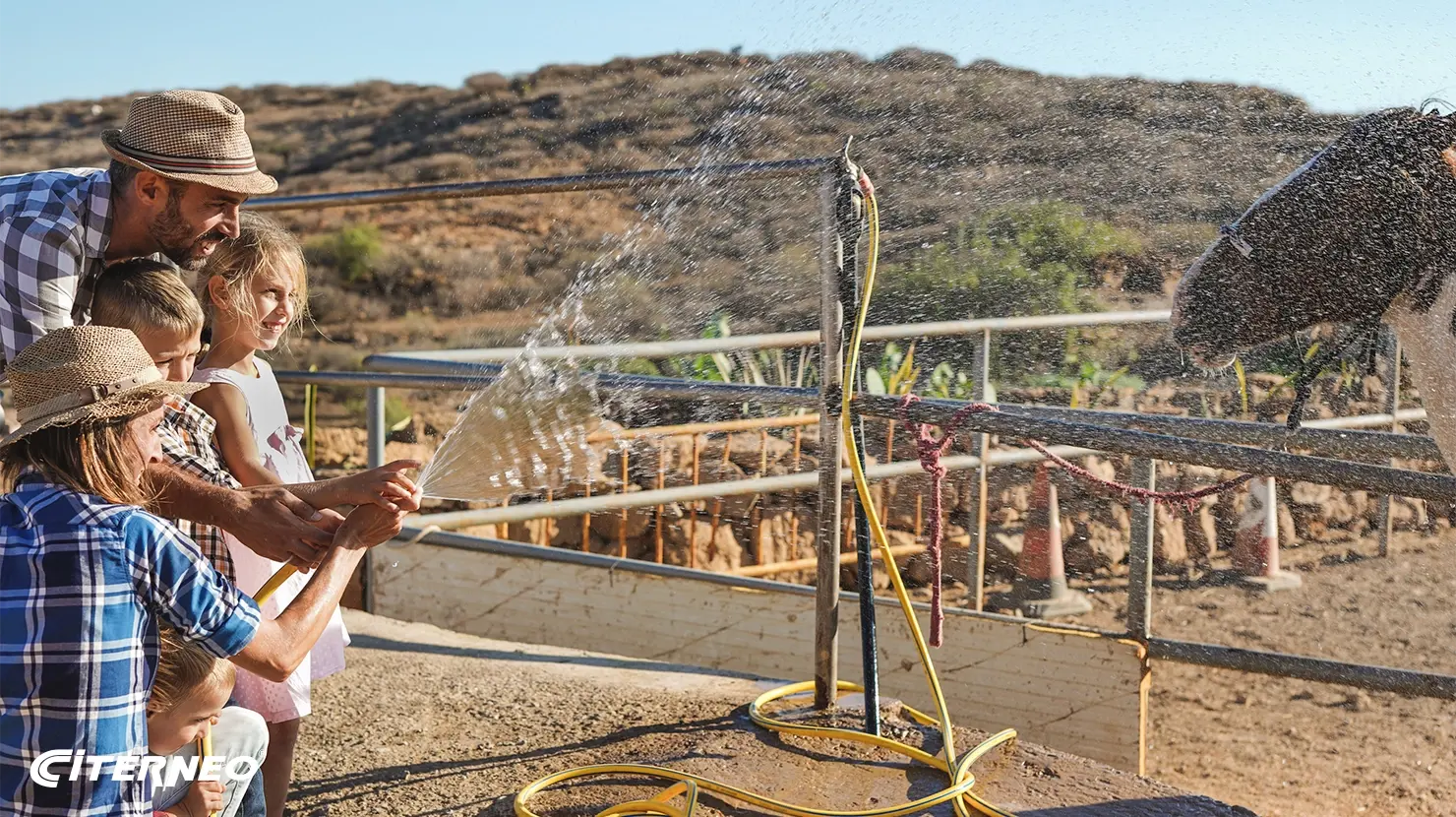
Every drop counts. Every liter counts. Every gesture counts.
While the need for water continues to grow, the resource remains limited.
Global warming has major consequences for water management and storage, as it accentuates periods of drought and flooding, causing a scarcity of usable water.
One of the challenges is to preserve the quantity and quality of water to ensure a quantity of fresh water available for the population.
The starting premise can be summed up as follows: we need to be able to collect and store water when it's available, in order to use it when there isn't enough, and when times are tight.
A clear statement of fact: Water resources are becoming increasingly scarce
In thirty years, water consumption has doubled worldwide, and is set to increase over the next twenty years.
Increasingly frequent natural disasters - floods, hurricanes, tsunamis and droughts - are a real threat to drinking water.
Disturbing figures on global access to drinking water
In 2019, a United Nations report estimated that more than 2 billion people faced a shortage of drinking water worldwide.
This same report notes that by 2025, 1.8 billion people will be living in areas of absolute water scarcity, and two-thirds of the world's population will be subject to conditions of severe water stress.
Global demand for water is expected to continue rising until 2050, 20% to 30% more than current demand.
The reason is well known: the number of inhabitants increases every year, but the quantity of available fresh water does not. The latter is no longer able to keep pace, giving rise to an increasingly worrying situation.
France is not spared. Even if our country is not currently experiencing a chronic deficit on a national scale, access to water is not guaranteed all year round and everywhere.
France is becoming aware of the water stakes
France has an available water reserve of 193 billion m³ per year, more than enough to satisfy the country's 32 billion m³ annual needs.
This gives our country a stockpile against potential levels of water stress that could affect the population - with each French person having access to 3,265 m³ per year, as established by the World Health Organization.
The WHO has set the threshold for water stress at 1,700 m³ per capita per year.
Christophe Béchu, the French Minister for Ecological Transition, presented the government's anti-drought plan in early 2023.
He says: "There will be a before and after summer 2022. Almost all départements have been affected by restriction measures, and the IPCC predicts between 10% and 40% drop in the level of our rivers by 2050. We must act." (Le Parisien, January 25, 2023).
These statistics underline the urgency of finding ways to sustainably manage our limited freshwater reserves.
How can we preserve water resources?
Often unknowingly, we lose and waste water. In this context, it is vital to study and implement measures to reduce water consumption and optimize its use.
This awareness to reduce and store water is slowly starting to take hold at all local and communal levels.
A climate emergency taken into account at State level
In the "anti-drought" plan that the Minister of Ecological Transition presented in early 2023, Christophe Béchu spoke of introducing a form of water "Ecowatt".
This would be a very local warning system in the event of a risk of drought, with simple gestures to be put in place upstream, to avoid having to limit water consumption afterwards.
Anticipating to better manage our water resources at the communal and local level
The various players involved at local level (local authorities, deconcentrated services, associations, etc.) have a role to play.
And there's no shortage of ideas: recycling rainwater, wastewater or taking advantage of municipal swimming pool drains.
Some local authorities, for example, have chosen to connect flexible tanks to the gutters of administrative buildings. The larger the roof surface, the greater the quantity of water recovered. Once collected, the water can be used for :
watering parks and gardens, sports fields
filling ornamental ponds
maintaining the cleanliness of roads, sidewalks and market squares
ensuring fire defense
Support is available, with some communes receiving subsidies from their département or water agencies to install flexible tanks.
Examples:
In Saint-Nazaire, water from the annual emptying of the Aquaparc is recycled to water green spaces and clean roads (≈ 900 m³ saved).
At Montoir-de-Bretagne, a tank recovers 10 m³ of rinse water every 15 days.
At Clermont-Ferrand, farmers use water treated by the wastewater treatment plant.
In Beaumont (Ardèche), an artificial basin stores water in the sand for the summer.
Simple gestures within the reach of every citizen
On average, in France, daily water consumption is 150 liters/person, of which 93% is for hygiene and 7% for food.
Simple gestures to reduce consumption:
limit circuit pressure to 3 bars
install a pressure reducer
choose class A household appliances
equip taps with hydro-economy mousseurs
install a thermostatic mixer, a shower-stop or a turbulence shower
equipping toilets with a dual-control flush
Outdoors, automatic watering and rainwater harvesters limit waste.
Finally, pipe maintenance is a huge potential source of water savings.
Are we ready to change our habits? What storage solutions exist?
Easy-to-implement solutions
The BRGM showed at the end of 2022 that water tables were low.
Anticipating this means storing rainwater in autumn for use during summer droughts.
Practical and economical water storage solutions
One of the most practical and economical solutions is the flexible tank.
Citerneo flexible tanks benefit from anti-UV and anti-fungal treatment, which guarantees:
unaltered, uncolored water
increased longevity thanks to the hydrophobic coating
protection against external pollution
absence of microbial growth thanks to the absence of air
Transportable, reusable and adaptable, they are suitable for local authorities, construction and public works, private individuals and industry.
Citerneo flexible tanks are certified Origine France Garantie and ISO 9001, with several quality labels (QB, CSTB, DWA).
Conclusion
By exploring rainwater harvesting technologies and other sustainable practices, everyone can help preserve freshwater resources.
Adopting the right approach means protecting the environment, ensuring a healthy future for future generations and saving money.
It's a concrete way of making a commitment to our planet Earth.