
Repeated flooding, summer droughts, heatwaves, new fire defense obligations: French communes, large and small, are now juggling diversified water constraints.
According to the 14ᵉ report by the Observatoire des services publics d'eau et d'assainissement (OFB, 2024), the average price of drinking water rose by around 1% per year between 2012 and 2022, i.e. a cumulative increase of almost 10% over ten years.
At the same time, the "Zero Net Artificialization" (ZAN) law imposes limits on the artificialization of land, making it more complex to create new water towers or traditional above-ground basins.
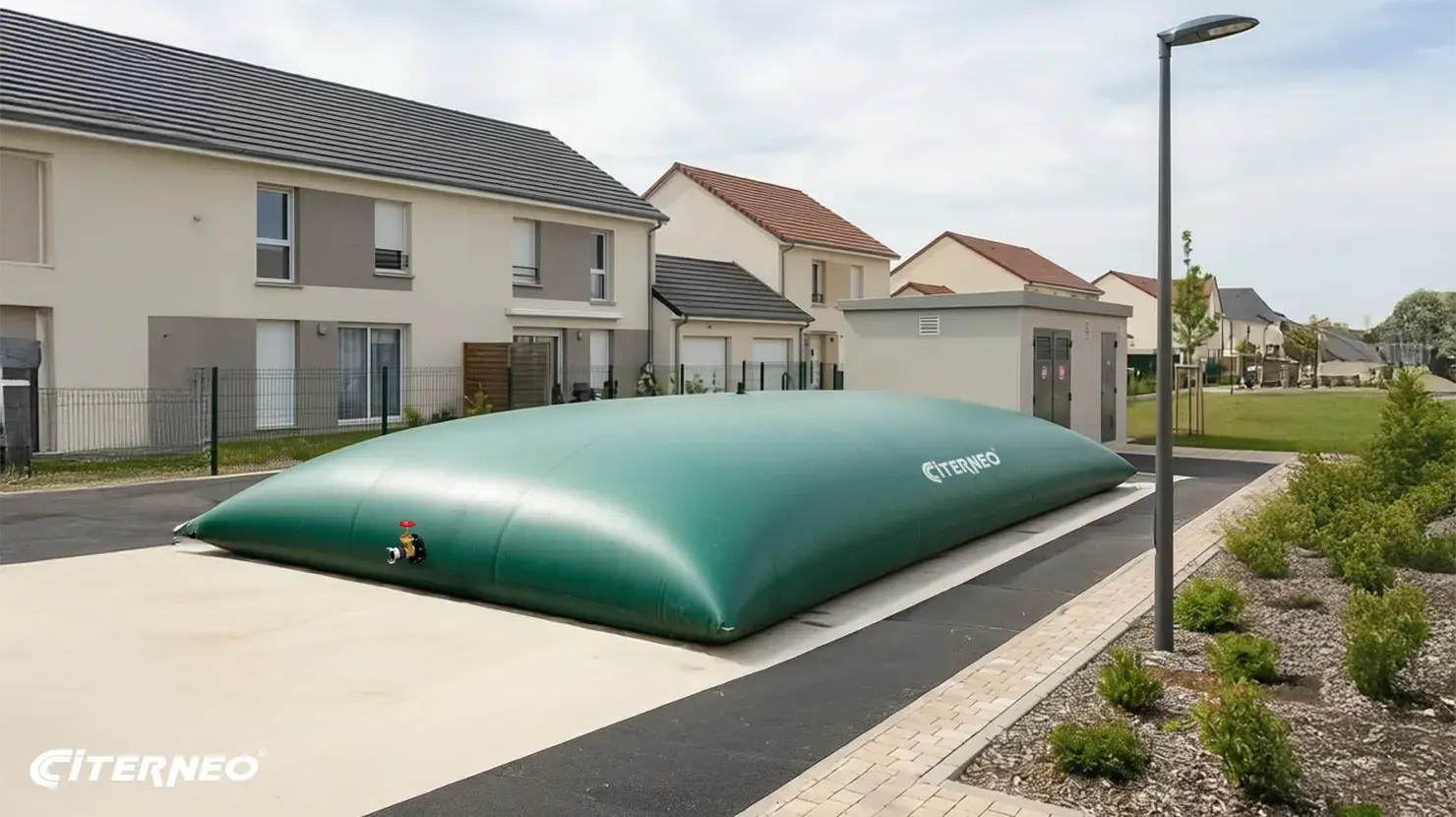
Faced with these economic and regulatory challenges, flexible tanks are winning over more and more local authorities: easy to transport (they fit folded on a pallet) and quick to install, they offer storage capacities ranging from 1 to over 2,500 m³ depending on requirements.
Their major advantage? Installation is carried out quickly, without heavy infrastructure: no concrete, cranes or major earthmoving or excavation operations are required.
Discover with CITERNEO how these water tanks meet local constraints while alleviating budgets.
Understanding the water management needs of local authorities
2.21 €/m³ in 2023, that's the average price of drinking water, with an average annual rise of around 1% over the last decade, or almost 10% over 10 years.
In fact, the total price (drinking water + sanitation) has also risen, by an average of 1.6% per year over the same period, or around 17% over 10 years, driven by the faster rise in collective sanitation.
Communities must therefore necessarily rethink their water management while adapting to new regulatory and financial constraints.
Rainwater management
Since the decree of July 21, 2015, building permits must incorporate the recovery or infiltration of roof water. In town centers where the rainwater network struggles to absorb stormy episodes, a flexible cistern connected to downspouts retains the first few millimeters of rain, and can reduce the peak flow sent to a wastewater treatment plant by 60%. The stored water is then used to water municipal flowerbeds or wash roads.
This is the case for the commune of Chargé in Indre-et-Loire, which has installed a 25 m3 flexible tank, Designed by Citerneo, a Touraine company based in Amboise, to clean its zero-phyto machines.
The commune of Barjouville, in the Eure-et-Loir region, has opted to install two flexible cisterns, each with a capacity of 200 m³, to collect and store rainwater. The first, installed in 2020 to limit wastage of this resource, was supplemented in 2023 by a second tank, bringing total storage capacity to 400 m³.
This is also the case for the commune of Pocé-sur-Cissé. Restrictions on drinking water and limitations on river pumping have complicated the upkeep of flower beds and lawns. To be more self-sufficient, the municipality decided to install a rainwater harvesting tank. This decision is part of an overall strategy: to exploit local resources, take advantage of existing infrastructures and secure watering during the summer.
The possibility of emergency drinking water storage
The interministerial circular of July 12, 2017 recommends that communes with fewer than 3,000 inhabitants ensure at least 48 h of drinking water reserves in the event of pollution. A 100 m³ Citerneo food tank installed in a multi-purpose hall thus covers the needs of a village of 900 inhabitants for two days, at a cost three times lower than a stainless steel tank of the same capacity.
Following the Al Haouz earthquake of September 8, 2023, in Morocco, Citerneo donated several 10 m³ flexible food tanks to the Moroccan Civil Protection. Deployed in less than 24 hours with MSF, they were able to ensure the distribution of drinking water to isolated villages in the Taroudant province.
Fighting off-grid fires
The SDIS (Services Départementaux d'Incendie et de Secours)require 120 m³ within 200 m of an isolated dwelling. When geology makes it impossible to build a masonry structure, a self-supporting flexible tank is a solution that complies with.... standards and is operational in 48 hours, certified by the NF S 62-250 standard.
This is the case in the commune of Pocé sur Cissé, which has had 4 flexible tanks dedicated to fire defense for around ten years. Installed in isolated areas where access to the drinking water network is limited, these tanks provide firefighters with a withdrawal point in case of need.
At Ligré (37), the commune is equipped with 13 Citerneo flexible tanks that were used by firefighters during a fire in this commune. Now refilled, the tanks are operational again. The conformity of a fire reserve is often a prerequisite for an insurer to grant compensation after a loss.
Real use cases in France of flexible cisterns by communes and intercommunalités
Faced with the increasing scarcity of water resources and the need to adopt sustainable solutions, more and more local authorities are choosing Citerneo flexible tanks to optimize water management and recovery in their facilities and public spaces
The Châtellerault nautical center's water management and reuse (Vienne)
When its basins are emptied, the water is first stored in tanks, then transferred to a 55 m³ reservoir. The chlorine evaporates naturally without chemical treatment, and once released, this water is reused to irrigate green spaces or clean public roads. This system, which operates all year round regardless of weather conditions, is a perfect illustration of how flexible cisterns can give swimming pool water a second life as part of a responsible and sustainable approach to resource management in urban environments
Rainwater recovery at the Parc Naturel Régional de Millevaches (Limousin)
In 2023, the Parc Naturel Régional de Millevaches organized a group of orders to equip the territory with 20 Citerneo flexible cisterns, from 5 to 20 m³ each, for rainwater harvesting. These tanks are made available to residents, businesses, local authorities and associations, as part of a climate change adaptation program supported by ADEME. They are used for watering, fire-fighting and managing increasingly frequent water restrictions.
Rainwater storage in Lhomme (Sarthe)
The village of Lhomme recently installed a 30 m³ Citerneo flexible cistern for rainwater harvesting. This capacity covers two months of communal watering and enables important water savings, while being part of a proactive civic and environmental approach.
Buffering rainwater to prevent flooding
Faced with increasing soil sealing and the risk of flooding, several municipalities are also using Citerneo flexible tanks to buffer runoff water during bad weather. The stored water can then be reintegrated into stormwater networks or used to maintain green spaces, contributing to urban resilience and reducing pressure on sewage networks.
These tanks are suited to runoff management and flood prevention, particularly in urban areas or during public works, and are often highlighted for their ease of deployment and modularity.
Multiple applications for these water tanks in urban environments
Flexible cisterns are also integrated into urban planning projects to collect and store rainwater in parks and public spaces, helping to maintain vegetation even in dry periods, limit flood risks and promote urban biodiversity.
The commune of Jaunay-Marigny has installed a 360 m³ flexible cistern in the grounds of the municipal swimming pool to recover winter water, which is then reused for watering green spaces or urban cleaning. A second tank has been deployed at the municipal technical center to collect rainwater. Thanks to this equipment, the municipality is able to limit urban runoff, relieve its sewage networks during heavy rainfall and guarantee the upkeep of public spaces even in periods of drought. This concrete approach illustrates how flexible cisterns, in an urban environment, promote the resilience of communities in the face of sustainable water management challenges

These concrete examples show that Citerneo flexible tanks are already widely adopted by local authorities in France for watering, rainwater management, fire fighting, pool water recovery, urban resilience in the face of climate change and new, original applications.
The principle of modularity: adjusting the volume and configuration of a flexible tank
The modularity of flexible tanks means that the volume and configuration of the tank can be precisely adjusted to suit the needs of the site, whether for one-off or permanent use, in an urban or rural environment.
Reduced carbon footprint
According to data from ADEME (Base Carbone v23) and CEREMA (Guide coûts travaux hydrauliques 2023), flexible tanks are distinguished by a particularly low carbon footprint and investment cost for capacities of between 50 and 200 m³.
Their design requires fewer materials than rigid tanks, reducing environmental impact right from production. Their light weight and ability to be transported folded optimize logistics and limit CO₂ emissions linked to transport and installation.
As for maintenance, an annual visual inspection and a pressure test every five years are all that's needed.
Furthermore, EXOM+ 130e and EXOM+ 140e composite textiles, chosen to manufacture our flexible tanks, now incorporate up to 30% less PVC. Lighter in weight, they reduce transport-related CO₂ emissions while offering enhanced mechanical performance.
| Solution (100 m³) | Target cost¹ (€ inc. VAT/m³) | Site duration | CO₂ footprint (kg eq) |
|---|---|---|---|
| Flexible tank | ≈ 280 | 2 days | ≈ 90 |
| Prefabricated steel tank | ≈ 650 | 8 days | ≈ 260 |
| Concrete basin (poured) | ≈ 1,150 | 18 days | ≈ 700 |
Longevity and recyclability: flexible tanks, a sustainable choice
The lifespan of modern flexible tanks reaches 15 to 20 years, with minimal maintenance, and most of the materials used are recoverable at the end of their life, helping to limit their overall environmental footprint.
All these features explain the growing success of these solutions with local authorities and businesses, who are looking to reconcile performance, carbon sobriety and adaptation to climate challenges.
2025-2030: flexible cisterns: a solution for the future of water management
Between 2025 and 2030, flexible cisterns will establish themselves as an inevitable solution to meet the challenges associated with water management: more frequent drought episodes, galloping urbanization, and tightened regulatory requirements.
Their modularity and ability to fit into tight spaces, including crawl spaces in basements, are appealing to more and more local authorities and urban players.
In particular, the technical innovations carried by Citerneo - which recently manufactured 2,500 m³ tanks for international use - enable storage to be precisely tailored to local needs, while reducing urban runoff and supporting biodiversity in the city.
In addition, ease of installation and low investment costs make these solutions accessible for projects involving rainwater harvesting, irrigation, or supplying urban cleaning systems.
By 2030, the widespread adoption of intelligent water management, combined with digitalization (IoT sensors, remote monitoring), should further enhance the attractiveness of flexible cisterns as a resilience tool in the face of climate change and dwindling water resources.
The widespread use of these connected devices also contributes to the ecological transition of territories, by promoting more refined and responsive management of water resources, essential in the face of today's climate challenges.
Conclusion
For local authorities, the flexible cistern is the ideal, multi-purpose tool.
Whether it's for rain harvesting, securing a fire reserve or building up a stock of clean water, the tarpaulin can be installed without major work, adapting to geography and lightening the bill. At a time when water resilience is becoming an indicator of good public management, this solution offers a relevant compromise between cost, speed and sustainability.