
Sustainable management of natural resources and preservation of biodiversity are now priorities in local policies. Some communes stand out for their bold choices in response to these challenges.
This is the case of Chargé, a rural commune in Indre-et-Loire, which focused its actions on biodiversity and reducing its environmental footprint long before this became a legal obligation.
Refusing any militant posture, the municipality has embarked on a transformation of its practices to maintain its public spaces differently.
One of the concrete aspects of this approach can be seen in the total abandonment of phytosanitary products in the management of roadways, parks and even the cemetery.
With this choice requiring new, more complex tools, a pragmatic question arose: how to clean these machines while respecting the environment?
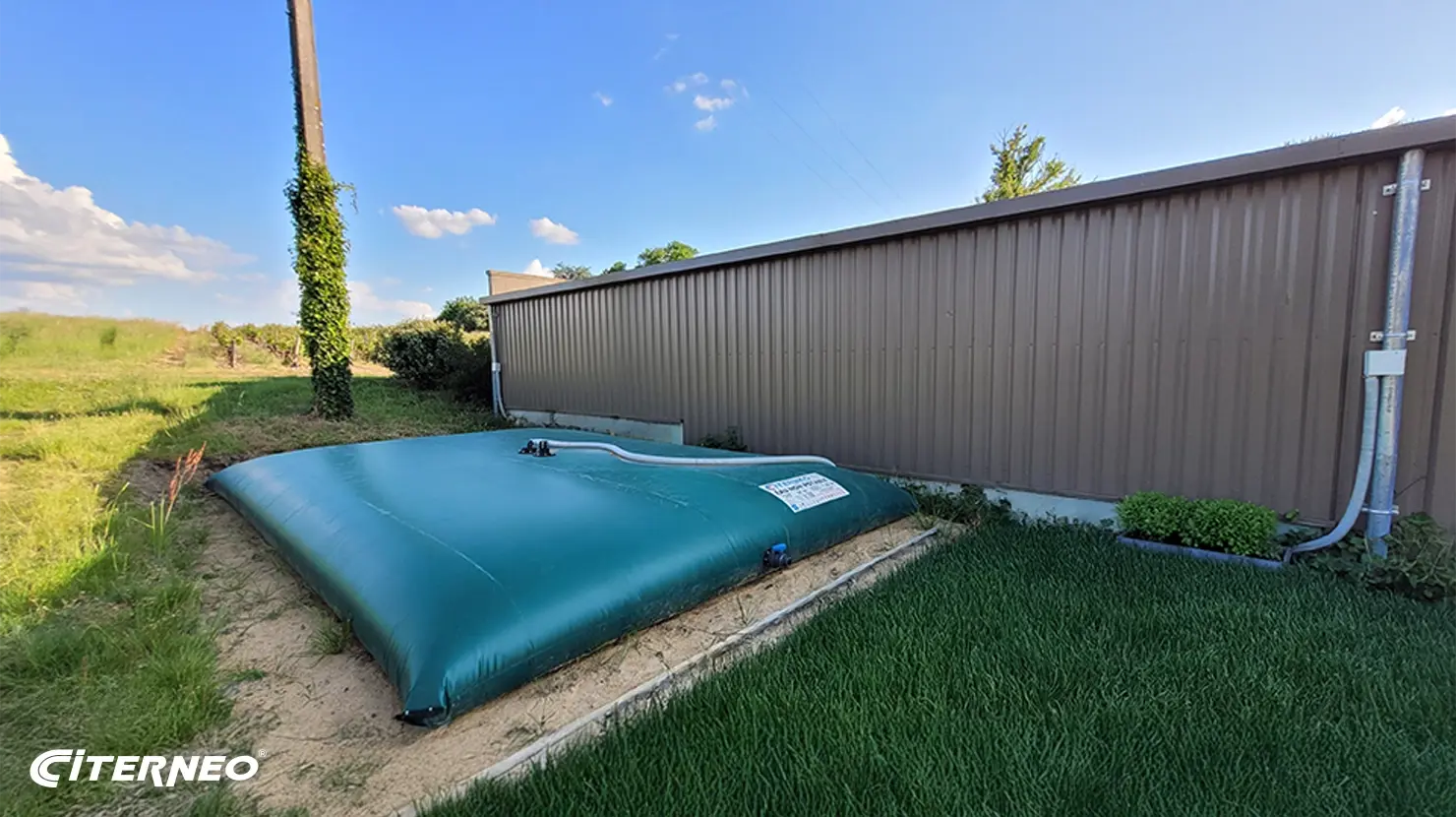
The answer came in the form of local cooperation with the company Citerneo, in the form of a rainwater recovery tank. A simple device that reveals a change in mentality: combining sobriety, realism and ecological commitment.
The commune of Chargé committed to zero phyto
A transition initiated in 2014 by the Touraine municipality
Since 2015, the commune of Chargé has gradually phased out the use of phytosanitary products in the upkeep of its public spaces. This shift took place voluntarily, without waiting for the regulatory deadlines imposed by the loi Labbé of 2017. The choice of zero phyto meets a logic of preservation of natural environments and public health.
This transition has required an overhaul of communal agents' working methods: an end to chemical sprayers, making way for manual and mechanical tools such as rotary brushes, thermal brush cutters or thermal weed killers.
These machines require rigorous maintenance and regular cleaning to maintain their effectiveness, hence the need for simple and reasoned access to a water source.
A gradual technical adaptation
To accompany this approach, the commune has built a new technical room dedicated to equipment maintenance. The idea of installing a rainwater recovery tank quickly emerged, but budgetary constraints delayed its realization.
In the meantime, the agents were using water from a communal borehole, involving travel and more complex organization. Yet the price of drinking water in France reached €4.30 per m³ in 2022, according to the Observatoire des services publics d'eau et d'assainissement.
The idea of a flexible tank: between technical need and local opportunity
A project put on hold for lack of budget
For several years, the municipality wanted to install a rainwater harvesting tank, but the overall cost (tank, connections, pump) made the project difficult to finance. In the meantime, staff had to make do with impractical drilling-based solutions.
A win-win collaboration with Citerneo
Citerneo, which specializes in the manufacture of flexible tanks for local authorities, farmers, industry, construction and private individuals, has a strong social commitment.
In order to produce quality tanks, the company regularly carries out tests on its models. These tanks, still in perfect condition, are offered locally for projects consistent with its values.
So, Citerneo graciously offered a tank to the commune of Chargé, enabling a long-delayed project to come to fruition. The installation took place at the end of 2024, reinforcing the bond of trust between the town council and the neighboring company.
A tank at the service of zero-phyto cleaning
Characteristics of the installed flexible tank
The model installed is a 25 m³ flexible tank, certified "Origine France Garantie", designed by Citerneo. It enables temporary storage of non-potable water, with clear instructions: maximum filling height and prohibited uses (drinking, food, swimming).
Zero phyto machines: precise, reasoned cleaning
The cleaning of machines (rotary brushes, thermal weeders, scrapers) is more than just rinsing. Agents have to remove plant residues, dust and splashes after each use. This process involves low-pressure rinsing and manual brushing, in an area suitable for water discharge.
A sober and functional use of rainwater
The flexible tank collects rainwater for cleaning equipment, avoiding the need for drinking water. A pump and a platform facilitate operations, in line with a logic of local autonomy.
A replicable eco-responsible model
This device saves on water bills and reduces the environmental footprint. Chargé's example illustrates the ADEME recommendation: favor alternative resources such as rainwater for non-potable uses.
Reception, challenges and prospects
A little-seen but seminal ecological action
This project embodies an innovative and sustainable approach. For mayor Pascal Dupré, these sometimes discreet initiatives lay the foundations for long-term change based on sobriety and resilience.
Towards sustainable territorial collaborations
The tank installed is to be secured by a fence. The town council is also considering a fire defense tank for an isolated building. Here again, Citerneo will be called in.
This partnership between local authority and local company illustrates that it is possible to build adapted and sustainable solutions on a territorial scale.
Conclusion
The installation of a tank for cleaning zero-phyto machines in Chargé symbolizes much more than a technical operation. It embodies a responsible approach based on sobriety, proximity and local initiative.
In a context of climate disruption, this initiative demonstrates that effective solutions are often born of common sense and territorial roots.
Thanks to this partnership, Citerneo confirms its societal commitment to the region's ecological transition.