
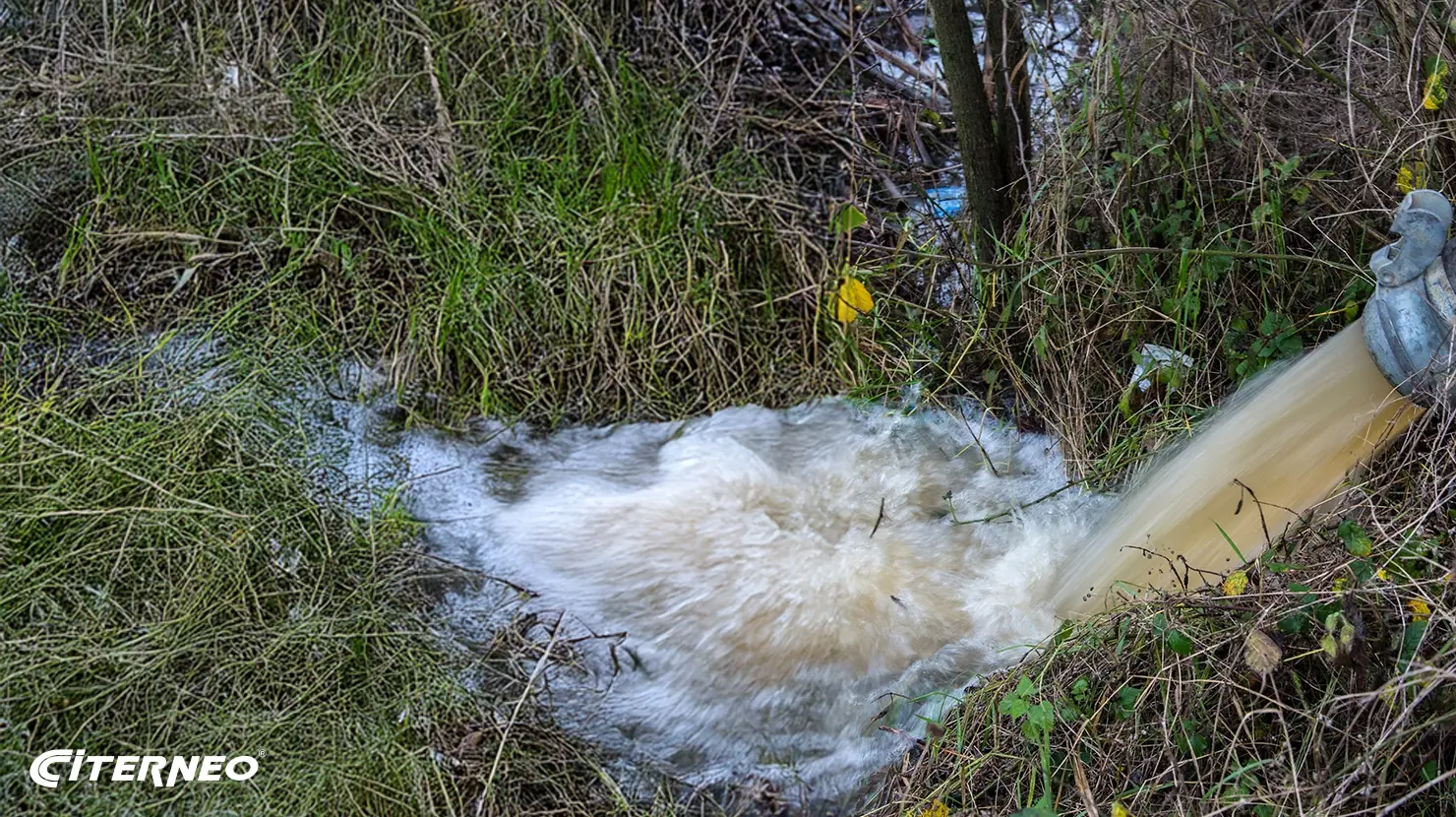
On October 12, 2023, 83 départements were in a drought situation and had taken measures to restrict water use (source Ministère de la Transition écologique et de la Cohésion des territoires).
This reality widens the gap compared to 2022, revealing an uneven distribution of water resources across our territory.
While drought is gaining ground in some départements, others, on the contrary, are not affected by water restrictions.
It is with this in mind that decree no. 2023-835, dated August 29, 2023, has seen the light of day to frame the uses and conditions of use of rainwater and treated wastewater. It makes a few changes to the regulatory framework arising from decree no. 2022-336 of March 10, 2022, which it repeals.
History and contextualization of decree no. 2023-835 on the reuse of rainwater and treated wastewater
French water legislation has evolved over the years, with growing awareness of this ecological emergency.
The history of water management decree no. 2023-835
The previous decree of 2022 had already laid the foundations for a more reasoned application of rainwater and treated wastewater reuse, but with a much more restrictive enforcement regime.
In fact, the decree of March 10, 2022, reinforced by an order of July 28, 2022, drew criticism for its application deemed too rigid and the introduction of complex administrative procedures, which may have hampered the initiative of many project developers.
For example, the former decree of March 10, 2022 did not mention the use of rainwater.
Thus, this new decree has seen the light of day to:
simplify the authorizations allowing treated wastewater to be used for certain purposes
standardize these provisions in the Environmental Code, including the conditions for general use of rainwater without the need for authorization
The aim is to make it easier for individuals and professionals to access an additional tool to cope with future water shortage episodes.
A new decree n° 2023-835 for simplification and clarification
This new measure meets a clear need for simplification.
It follows on from the Plan Eau presented on March 30, 2023 by the President of the French Republic, which notably calls for the reuse of 10% of wastewater by 2030.
Decree no. 2023-835 of August 29, 2023 on the uses and conditions of use of rainwater and treated wastewater was published in the Journal Officiel of August 30, 2023. It repeals the previous decree and makes a number of amendments to the Environmental Code.
It creates a new section 8 entitled "Usages et conditions d'utilisation des eaux de pluie et des eaux usées traitées" ("Uses and conditions of use of rainwater and treated wastewater") within chapter one of the regulatory part of the Environmental Code.
Its main objective is to facilitate the procedures for obtaining the necessary authorizations for the reuse of treated wastewater. It specifies how rainwater can be used in non-domestic contexts.
Today, this new decree reinforces this approach, adapting to the challenges of climate change and the need to preserve our most vital resource.
What does the new water management decree propose
What does this new decree reveal about rainwater reuse? That's the question.
An innovative decree
This decree innovates by redefining the use of rainwater and treated wastewater. For non-domestic sectors, the text establishes strict standards, guaranteeing irreproachable sanitary quality.
It also paves the way for more flexible use of wastewater in agriculture, subject to administrative authorization, while excluding its use in homes, health establishments and schools, to prevent health risks.
The aim is to guarantee responsible use of this water and ensure sanitary quality.
The decree of August 29, 2023 therefore points out the following points.
Duration and viability of rainwater management projects
The 5-year limitation for projects, as imposed by the decree of March 2022, is removed. Treated wastewater reuse projects are no longer restricted to a 5-year experimental period.
A simple opinion from the health authorities is now required instead of an assent. In addition, the volume of reusable water is increased.
This is a relaxation that simplifies life for many communes.
Lighter monitoring reports
From now on, authorization holders are no longer required to submit an annual report to the prefect. Instead, every five years they must provide a detailed report assessing the health, environmental and economic impacts of their project. This report is then forwarded to the departmental council for the environment and health and technological risks, for its opinion.
Elimination of geographical restriction
The new regulations allow treated wastewater to be reused from one department to another neighboring department, thus removing previous geographical barriers.
Change on sludge quality
The new regulations eliminate the previous requirement to link the use of plant water to the quality of the sludge produced.
This decision, influenced by feedback from industry professionals, is based on the argument that sludge quality does not necessarily reflect that of the treated water.
Simplification of dossier instruction
The approval of health authorities for water reuse dossiers was no longer required in the previous decree.
However, a recent amendment, following the intervention of the Conseil d'Etat, stipulates that this opinion is now considered unfavorable by default, to reinforce the legal soundness of authorizations and limit potential litigation.
In short, this decree highlights an evolution towards a more sustainable and responsible approach to rainwater and wastewater management.
This management is aligned with current environmental issues and the need to preserve water resources.
What are the repercussions for everyday users?
The new regulatory framework brings changes to water management, aimed at facilitating its collection and reuse.
Valuing rainwater
Rainwater collection and use are now exempt from any authorization procedure.
This refers to water collected downstream of inaccessible roofs (where the water runs downhill).
This measure aims to encourage the collection and use of this resource, making it easier for individuals and local authorities.
This considerably increases the volume of rainwater reused, reducing pressure on drinking water resources.
The aim is to use this rainwater freely outside your home, to water your garden or clean your car.
The reuse of treated wastewater is still subject to obtaining authorization. However, the process has been simplified: applicants will no longer need to seek assent, but a simple opinion from the health authorities, notably the Agence Régionale de Santé and the CODERST (Conseil Départemental de l'Environnement et des Risques Sanitaires et Technologiques).
This amendment eases the administrative burden, making the use of treated wastewater for specific applications more accessible.
Clarification on the use of rainwater
This resource is not only authorized, but encouraged for outdoor watering for landscape and aesthetic purposes (watering, swimming pool,...) . Aligned with the Environment Code, this measure aims to promote eco-responsible water management, as the decree encourages this practice.
It simply specifies that rainwater must not be used inside dwellings for domestic purposes.
The decree of August 29, 2023 makes it possible to use rainwater without an authorization procedure (cf. new article R. 211-123).
It further defines rainwater as "that resulting from atmospheric precipitation collected downstream from surfaces inaccessible to people apart from upkeep and maintenance operations." (cf. article R. 211-124).
Storing water to anticipate droughts
The use of rainwater is now possible without any authorization procedure.
This means that every private individual and professional can recover rainwater and store it in a flexible tank, for example, to cope with drought episodes, which are multiplying, and thus protect themselves.
Be aware that there have been some misinterpretations of the text on "the use of rainwater inside residential premises and for domestic purposes", as this provision does not fall under the Environmental Code, as the decree seems to imply, but is "governed by the Public Health Code". This clarification has been indicated by the Ministry of Ecological Transition on its website.
If you would like to know more about this, please refer to the decree of August 21, 2008 on rainwater harvesting and its use inside and outside buildings."
It states that rainwater collected downstream of inaccessible roofs "may only be used for excreta disposal and floor washing", and "on an experimental basis, for washing clothes".
This text is part of a broader desire by the legislator to encourage the use of rainwater.
Some prohibitions remain on the reuse of rainwater and wastewater
The use of treated wastewater and rainwater remains prohibited in :
social, medico-social, healthcare, elderly accommodation establishments
medical or dental practices
medical biology analysis laboratories
blood transfusion establishments
nurseries, nursery and elementary schools
other establishments receiving the public during hours when they are open to the public.
The use of treated wastewater is prohibited for the following purposes:
food, including drinking
preparation, food preparation, cooking and preservation
dishwashing
body and laundry hygiene
using water for swimming pools and whirlpool baths
spraying misting
water games
public decorative fountains
watering green spaces in buildings
Perspectives and conclusion
In conclusion, this decree no. 2023-835 is intended to raise awareness of a heightened ecological consciousness.
It loosens the regulatory bridle by simplifying the authorization regime allowing treated wastewater to be used for certain purposes, and to do so "while respecting the health of populations and ecosystems".
It also prompts deep reflection on our relationship with water, highlighting the importance of each drop in the great cycle of life.
This legislation, far from being binding, represents an opportunity to reinvent our water management, for the good of our planet and future generations.
It's worth remembering that today in France, only 1% of water is reused. In Italy and Spain, this rate climbs to 10%.
For the year 2030, Emmanuel Macron has set himself a target of 10% for wastewater reuse.