
I'm a drop of water. I'm microscopic and liquid, yet I belong to a huge world. With all my fellow creatures, we occupy three-quarters of the earth's surface.
I can be salty, sweet, drinkable, worn, fresh or repulsive by dint of encountering obstacles and the living beings that populate the planet, flora and fauna included.
And yet, I'm essential to the lives of everyone, especially those whose sustainability and future I can only ensure by being drinkable.
Where do the drops of water that fall from the sky go?
The life of a drop of water is not a long quiet river, its journey is rocky.
A novel aquatic journey
At first, everything is simple. The drops sit quietly on the surface of oceans, seas, rivers and lakes.... And when the sun shines and the heat rises, they are forced to evaporate and climb into the atmosphere.
However, as they gain altitude, cooling takes place. Together with the other evaporated water droplets, they soon form a cloud and condensation occurs.
Here they are again, a drop of water, invited to return to the ground simply by following the law of gravitation.
The fate of a drop of water
Their destiny is then multiple, as it depends on temperature, wind direction and speed.
Thus, it may fall back into the sea, into a stream, onto loose soil or infiltrate to contribute to plant growth.
Or it may fall into a water table.
Or it may even fall onto a glacier, where it turns into snow and then back into drops of water as the snow melts, forcing them to trickle down until they reach the next stream that will take it to the sea or ocean.
Or finally turn into hail when temperature, pressure and wind force it to do so.
It can mix with numerous pollutants by joining the "wastewater".
And then it has to be transported, stored and purified to put it back into circulation. It's the eternal beginning of water's life cycle.
What happens to the raindrops that fall? What is their journey?
A drop of water falling on the summit of Mont Blanc will have to travel 711 kilometers to reach the Adriatic Sea! This very serious calculation has been modeled to follow the journey of a raindrop, from the moment it falls from the sky, to the moment it flows into the sea.
A journey worthy of a great epic
If you're curious, you can visit Global River Runner, which visualizes the path taken by a raindrop.
It's an open source Work In Progress that simulates its journey, passing through streams, then on to its destination, in most cases an inland body of water or the ocean.
Another example, from Paris, a raindrop travels a distance of around 342 kilometers, before ending its journey in the English Channel. (source France Live).
Most often, rainwater is eagerly awaited on dry land. Inhabitants, like farmers or even city dwellers, are more and more numerous to wait and hope for this rainwater to refresh themselves, nourish the earth or even conserve it for all the benefits and care it brings.
The possibilities for storing this water that falls from the sky appear both numerous and imaginative.
Rainwater tanks as storage solutions
Rainwater tanks, rainwater harvesters, flexible tanks or flexible cisterns, anything goes to keep those drops of water warm. Objective: to store water in rainy periods for use in more stretched periods (e.g.: summer period)
Collection systems are thus installed from waterfall points to conduct these thousands of droplets into all sorts of reservoirs.
As cities continue to grow, the concomitant artificialization of land and the permanent increase in population are likely to weaken this balance, for while the total volume of water available worldwide is significant, the freshwater accessible is diminishing.
Until recently, little thought was given to this evolution, so much so that its sufficient presence seemed a matter of course.
Where does the drop of water that arrives in the city fall? What is its path?
This is the question that comes up again and again: where do the raindrops that trickle down onto our umbrellas, rain jackets and sidewalks end up?
A multiple water cycle that repeats itself indefinitely
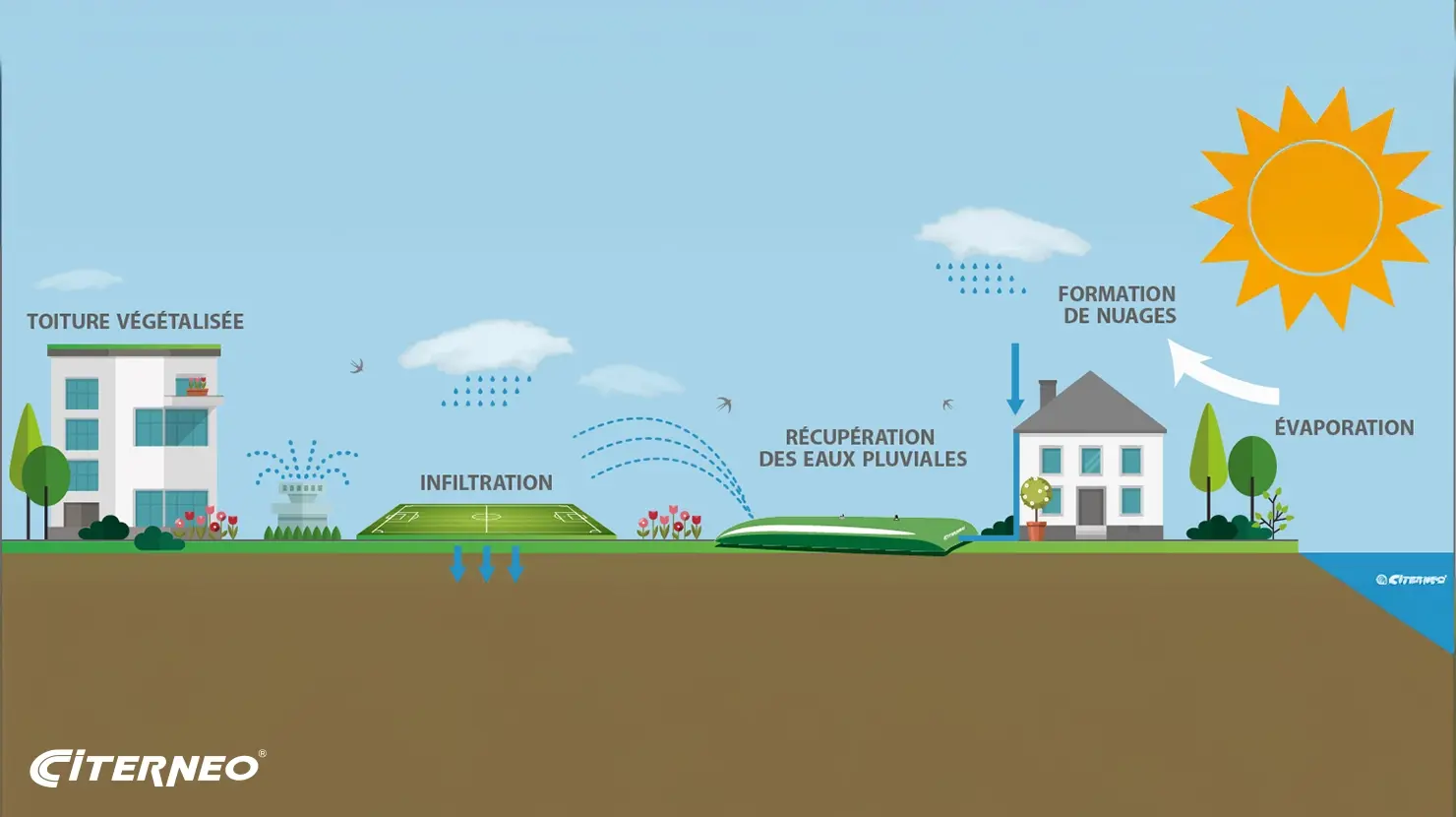
The water drops that fall in city centers generally follow a complex circuit. When they fall on roofs, roads and sidewalks, they can flow into storm sewers, which then direct them into retention basins or rivers.
In some cities, raindrops can also be collected in rainwater harvesting tanks to be used later for irrigation or other non-potable uses.
Some of it can also infiltrate the soil whether in green spaces or unpaved areas. This helps to recharge water tables and prevent flooding.
However, in highly developed urban areas, most surfaces are impermeable, meaning that drops of water cannot infiltrate into the ground and run off into sewers. This can lead to overflows as well as pollution of rivers and then oceans.
At the end of the day, the circuit of water drops in communes depends largely on the city's stormwater management infrastructure, as well as the composition of the soil and the presence of green areas.
What are the solutions for intelligently capturing this providential water that falls from the sky?
There are several solutions for better managing rainwater in cities, such as:
rainwater harvesting, which involves collecting rainwater in recovery tanks, such as flexible cisterns. This water can be used for irrigation, cleaning and other non-potable purposes. This reduces the amount of drinking water used for these activities and relieves demand in times of drought.
vegetated green roofs help absorb rainwater, reducing runoff and the load on drainage systems. Green roofs improve air quality, reduce the urban heat island effect and provide habitat for local wildlife.
permeable pavements such as permeable pavers and porous concrete, which allow rainwater to soak into the ground rather than run off impervious surfaces. This reduces the load on drainage systems and helps recharge water tables.
rain gardens, which are landscaping features that capture rainwater and let it seep into the ground. They can be installed along sidewalks, roads and parking lots to reduce runoff and improve water quality.
retention basins which are areas designed to collect and store rainwater temporarily before releasing it slowly into storm drains. This reduces the risk of flooding and helps remove pollutants.
Stormwater management
An estimated 16% of runoff feeds rivers and seas, while 61% returns to the sky as evaporation - until the cycle repeats itself again.
Stormwater has a unique capacity to be contaminated by pollutants from its surroundings. It is therefore essential to manage stormwater at source through infiltration strategies.
This approach is not only environmentally friendly, it also prevents the destruction of an already fragile ecosystem.
Therefore:
manage rain where it falls
reduce the volume and flow rates of rainwater discharged into the network and the natural environment
Integrate water management within municipalities
storing water where possible
recovering wastewater for treatment and reuse
Dewaterproofing and revegetating urban spaces, infiltration, making water available to vegetation and recovering it for local uses are becoming a priority.
Rainwater represents more than ever a resource to be preserved and valorized, particularly in cities.
Does rainwater storage deplete water tables?
In France, around 900 mm of rain falls every year, but only 40% reaches the water tables or rivers, while 60% evaporates.
100% of rainwater doesn't make it to the water table, as many parameters come into play, such as soil type, vegetation, rain intensity, temperatures or the rate at which the soil dries out...
To answer this question properly, we need to distinguish between town and country.
In the city, with soil sealing, rainwater is mainly discharged into streams and tributaries, which can create flood phenomena.
It's this lost water that it can be interesting to recover, as at this point, the infiltration rate into groundwater is virtually nil.
Storing rainwater, for example in flexible cisterns, does not therefore deplete the water table, as this water, which does not infiltrate, is stored to meet standard needs. Storing this water also avoids the need to use groundwater.
In the countryside, the agricultural world does not have the same needs. Agriculture accounts for around 9% of water withdrawals, mainly for irrigation, and represents 48% of consumption. This is the sector that "consumes" the most water, as the water taken by plants is not returned. It re-enters the cycle in the form of steam, before falling elsewhere in the form of precipitation.
Installing flexible pockets doesn't deplete groundwater either, as rainwater tanks like flexible cisterns offer a constant storage volume unlike open pits. A closed structure prevents evaporation, external pollution from insects and leaves, for example, or the risk of falling, and confines odours.
The water resource is thus preserved.
Conclusion
Present since the "big - bang" , a simple drop of water still has an extraordinary destiny.
At the surface as well as within the planet, it lives surrounded by the gigantic volumes of its fellow creatures, ensuring the planet's future from the outset.
Resource management, hydrology, irrigation, agroecology, recycling, hydroeconomics.... there are many ways to achieve a new balance.
Take care of them! These drops of water represent the guarantee of your future on earth.