
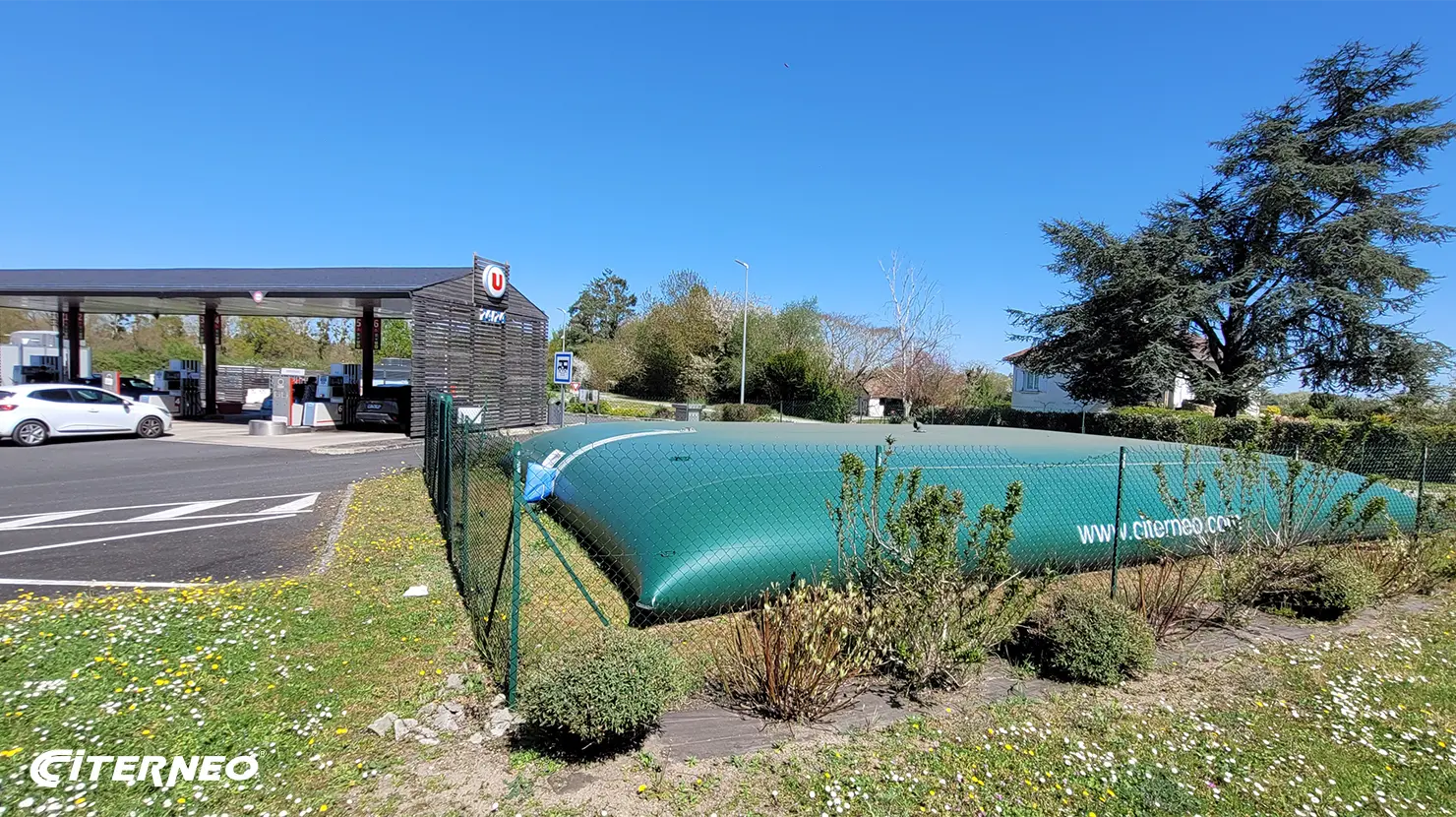
Flexible tank: an environmental and sustainable solution for water management
Water is becoming increasingly scarce. Resources are dwindling. With this in mind, there's a simple solution: flexible tanks. These flexible tanks save water that would otherwise be lost. Flexible tanks are more than just containers. They are made from resistant materials, offering a sustainable alternative to traditional water storage systems.
Their environmental and economic impact merits detailed analysis.
Flexible tanks, an asset for the urban environment
Flexible tanks are emerging as a useful response to improving the resilience of cities in the face of climatic hazards.
Their ability to effectively store rainwater helps to significantly reduce urban runoff. This phenomenon, often the cause of flooding and river pollution, is thus mitigated.
The collection of rainwater by these devices also relieves the strain on sewerage systems, which are often saturated during heavy rainfall. Local authorities can thus better manage peak rainfall and limit the risk of flooding.
In Jaunay-Marigny, the installation of a 360 m³ flexible tank in the grounds of the municipal swimming pool illustrates this proactive approach.

Tanks to support urban biodiversity
Beyond stormwater management, flexible tanks play an active role in creating more sustainable green spaces in the city. Stored water can be used to irrigate parks and gardens, even in times of drought. This constant availability of water encourages the maintenance of vegetation and, by extension, urban biodiversity.
The creation of green roofs is an important asset in the fight against atmospheric pollution.
Increasingly popular, these vegetated spaces, fed by reclaimed rainwater, play a decisive role in the thermal regulation of buildings and the purification of urban air.
Flexible tanks are thus part of an overall approach to greening cities, helping to improve the quality of life for city dwellers.
Installing a flexible tank guarantees an economical investment
Compared with traditional storage systems, flexible tanks like tanks offer significant financial advantages. Their acquisition cost is generally lower than that of rigid tanks, particularly for medium to large volumes.
Flexible tanks are also more economical to install. Unlike rigid tanks, which often require substantial earthworks, flexible tanks can be deployed on a simple flat surface. This ease of installation considerably reduces labor and material costs.
An adaptable, environmentally-friendly solution
The flexibility of these rainwater harvesters is a real asset in urban environments where space is often limited. Their ability to adapt to different terrain configurations allows them to blend unobtrusively into the landscape.
This feature is particularly appreciated in areas where architectural or heritage constraints are strong.
Furthermore, the lightness of the materials used makes these tanks easy to transport and install. This quality proves invaluable in areas that are difficult to access or where the use of heavy machinery is restricted.
Flexible tanks thus offer a minimally invasive water storage solution that respects the existing urban environment.
A product of resilience in the face of climate change
In a context of increasing drought episodes, flexible tanks are emerging as a resilience tool for communities and individuals. They can be used to build up substantial water reserves for use in times of water stress.
This storage capacity helps to reduce pressure on drinking water resources.
Agriculture, a sector particularly vulnerable to climatic hazards, finds these flexible tanks a solution tailored to its needs. They offer farmers the possibility of storing rainwater or agricultural effluents, thus promoting more sustainable resource management.
This approach is fully in line with the principles of conservation agriculture, aimed at optimizing water use and reducing the environmental impact of agricultural practices.
A tool for raising awareness of water management
Beyond their technical and economic aspects, flexible tanks play an important educational role. Their visible presence in urban or private spaces raises public awareness of the importance of sustainable water management. They are a concrete embodiment of the principles of the circular economy applied to water resources.
Initiatives by local authorities, such as Jaunay-Marigny, demonstrate the potential of these installations to educate citizens about the challenges of water conservation. These pilot projects often serve as catalysts for broader actions to raise awareness of the environment and responsible management of natural resources.
Community awareness for sustainable water management
Communities need to set an example and learn how to save water to reduce their environmental footprint.
Flexible tanks enable them to transform their water management by storing water for multiple uses :
regulating stormwater networks and limiting flooding
compliant with regulations on regulating water discharges
maintaining green spaces and preserving their label as a village in bloom
using non-calcareous water at room temperature, promoting plant growth
securing fire defense and fighting fires
watering parks, gardens and sports fields
clean service vehicles
recover water from swimming pools
feed misters in public spaces
feed ornamental ponds
keep roadways clean, sidewalks and market squares
By adopting these devices, municipalities make significant savings on their drinking water consumption and associated costs.
Towards increasingly efficient and innovative flexible tanks
Innovation in the field of flexible tanks continues to progress. Current research focuses in particular on improving the thermal performance of these devices. The aim is to limit the heating of stored water, thus preserving its quality and reducing the risks of bacterial proliferation.
This is the case with Touraine-based company CITERNEO, which is innovating in several areas. Certified ISO 9001, QB09 (CSTB) and "Origine France Garantie", it demonstrates its commitment to quality and French know-how in the field of sustainable water management.
It has developed the SYSTEM LOWICK treatment, which prevents the formation of mold, thus extending the product's lifespan. The CLEANGARD finish, applied to both sides, facilitates maintenance and enhances weather resistance.
In addition, CITERNEO has created and designed EXOM+ 130e and EXOM+ 140e composite fabrics. These new materials combine performance and environmental responsibility.
EXOM+ 130e stands out for its composition incorporating up to 30% less PVC, while improving its mechanical properties.
This innovation reduces the product's carbon footprint, notably through a reduction in CO₂ emissions linked to transport, as the fabric is manufactured in France.
Conclusion
Flexible tanks are asserting themselves as a forward-looking solution to the challenges of water management in a context of climate change. Their positive impact on the urban environment, coupled with their economic advantages, make them valuable tools for communities and individuals.
The growing adoption of flexible tanks bears witness to a shift in thinking towards a more responsible and sustainable approach to natural resource management. These solutions, at the crossroads of ecology and economics, perfectly illustrate the transition towards development models that are more respectful of our environment.