

It's never rained so much in 26 days. Between October 18 and November 12, 2023, an average of 215.4 mm fell across the country, according to Météo France.
You have to go back to 1993 to observe such a cumulative volume of rainwater: 196.9 mm between September 21 and October 16 (over the same 26-day period).
Remember, first it was storm Ciaran that devastated Brittany, then it was Domingos and Elisa's turn to hit Nord-Pas-de-Calais; a total of 3 storms that caused unprecedented high water and flooding.
Did this abundant rainfall in late October and November have a beneficial impact on the water tables?
That's the question on everyone's mind.
Contextualization for an unprecedented cumulative rainfall record at the end of 2023
Canicles, floods, drought... France is not spared the consequences of global warming.
Water tables faced with extreme events
Extreme weather phenomena have followed one another for several years with
-heat waves such as during the record-breaking summer of 2022, with differences of up to +12°C between rural areas and the biggest cities
- summer 2023 also saw a late heat wave, from August 17 to 24.
- water shortages, with more frequent and intense periods of drought leading to restrictions on water use
- flooding: France is one of the European countries most threatened by coastal flooding. This risk is further exacerbated by the volume of precipitation, which is more intense in some regions, and less absorbed by soils degraded by drought.
+1.9°C: this is the current level of warming in France according to the latest report by the French High Council for Climate.
On a global scale, this warming is estimated at +1.1°C.
The impact of flooding on water tables
The year 2023 thus marks a sad record. In France, unprecedented rainfall has left its mark on the territories. It had never rained so much in 26 days, between October 18 and November 12, 2023.
These phenomena, amplified by global warming, are no longer exceptions but indicators of a climate in the throes of change.
What is the impact of these floods on the water tables, those underground reservoirs of water essential to our environment and our survival?
The water tables are directly influenced by climate change. Traditionally considered stable and reliable reserves, they are now subject to major water stress.
On the one hand, prolonged periods of drought reduce their natural recharge. On the other, sudden and intense floods, although appearing to bring them a surplus of water, pose new challenges.
These extreme events can lead to rapid saturation of shallow aquifers, causing flooding and ecological imbalances.
Inversely, some deeper aquifers struggle to replenish themselves, even in the face of abundant rainfall.
This complex situation raises questions about the management and preservation of these essential water resources, in a context where extreme weather events are becoming the new norm.
The impact of record rainfall on water tables
Water tables are traditionally recharged by rainfall infiltration and river runoff.
However, in the current context, their replenishment is becoming increasingly unpredictable and random, depending on a number of criteria.
How do water tables react?
During periods of prolonged drought, water tables experience a drop in level, as insufficient rainfall fails to compensate for water consumption and natural evaporation. This drop in level can have significant consequences, ranging from reduced water quality - due to increased concentration of pollutants - to supply problems for agriculture, industry and households.
On the other hand, during heavy rainfall or flooding, some water tables, particularly those that are shallow or located in geologically sensitive areas, can quickly become saturated.
This rapid saturation can lead to flooding, with the consequences of significant property damage and risks to public health.
In addition, too rapid an infiltration of water can prevent natural filtration by the soil layers, which can lead to the contamination of groundwater by pathogens or pollutants.
The behavior of groundwater in response to these events depends on its geographical location.
For example, alluvial aquifers, often located close to rivers, are particularly vulnerable to flooding, while aquifers located in rocky or mountainous areas may have a slower but more stable recharge capacity.
Faced with this reality, it is becoming essential to understand and monitor the dynamics of these aquifers in the context of climate change, in order to develop appropriate management strategies.
This involves efforts both in terms of scientific research, and the implementation of water management policies.
Objective: to ensure the sustainability and resilience of these essential resources in the face of the challenges posed by excessive climatic events.
The hydrogeological situation on December 1, 2023
The heavy rainfall that marked the end of October and November had a positive effect on the water tables. 41% of levels are up.
The infiltration of precipitation into the deep soil layers has contributed to a significant improvement in so-called reactive water tables, while the effect is more moderate for water tables with higher inertia.
Definition of a so-called reactive water table
A so-called "reactive" water table refers to an underground water table that responds rapidly to variations in precipitation. It is a water table found at shallow depths. It traditionally supplies wells and springs with drinking water.
This type of groundwater has specific characteristics that influence its behavior in the face of surface water inflows. They show an almost immediate response to precipitation events. They recharge or empty rapidly depending on water inflows or deficits.
Management of these aquifers requires particular attention to prevent flooding and ensure a sustainable water supply.
Definition of a so-called inertial groundwater table
A so-called "inertial" groundwater table refers to an underground water table that reacts slowly to variations in precipitation and environmental changes.
Inertial groundwater tables are generally deeper compared to reactive groundwater tables. This characteristic means that rainwater takes longer to infiltrate and reach the aquifer, creating a delay in its recharge or emptying.
Due to their depth and reduced permeability, inertia aquifers show a slow response to climatic variations and precipitation events. Their recharge or emptying occurs over extended periods.
Managing inertial aquifers requires a long-term approach, taking into account their slow adaptation to environmental changes. This implies continuous monitoring and long-range forecasting for sustainable management.
Perspectives and evolution of flooding on water tables
The Bureau de Recherches Géologiques et Minières (BRGM) provided an update, on Thursday December 14, 2023, on the situation of French water tables as of December 1.
Result: the situation is improving, even if many aquifers are still at below-normal levels.
The state of the aquifers remains geographically highly contrasted.
This hydrogeological improvement is not uniform across the country.
At total, "41% of observation points are below monthly normals", BRGM reports.
This is less than on November 1 (65%). Above all, it's less than last year at the same time, when 70% of monitoring points showed levels below normal.
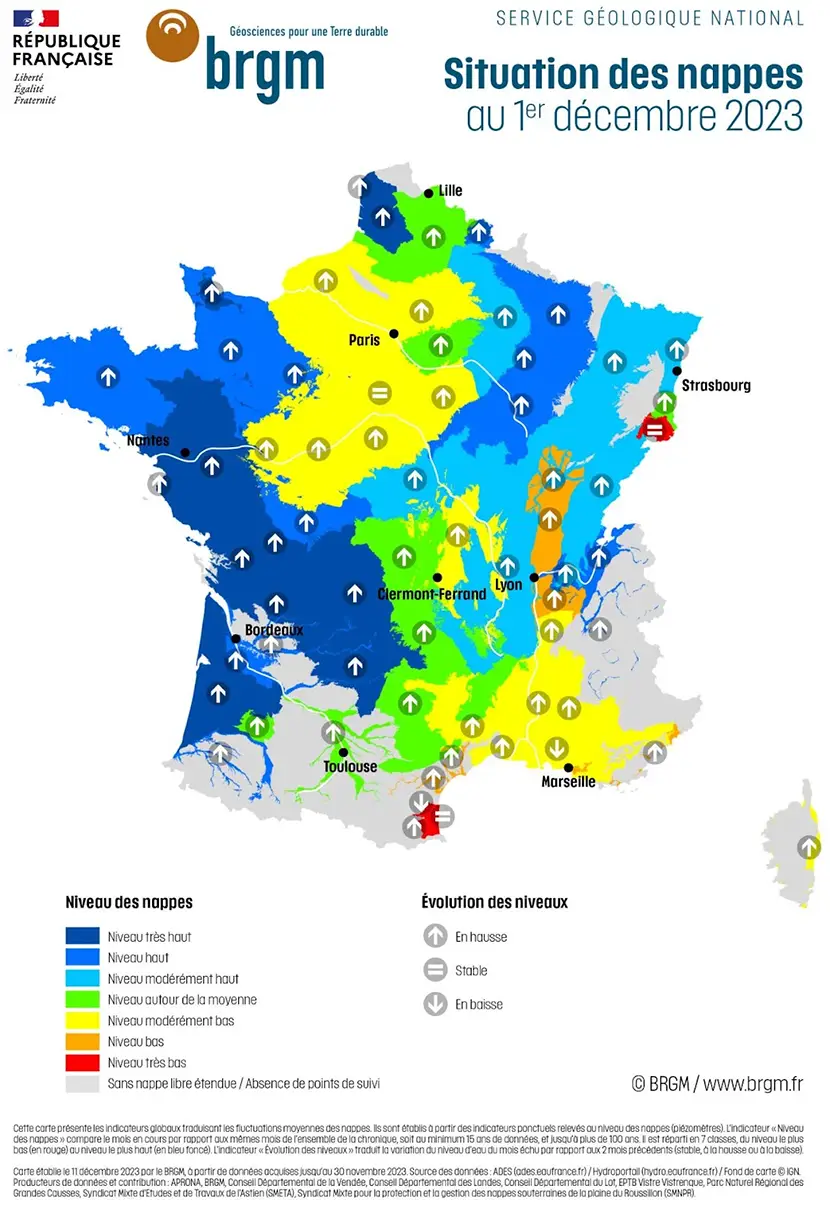
While reactive aquifers in northern and southwestern France are showing very favorable levels, those in Corsica, the Mediterranean rim, the Limagne plain, the Rhône-Saône corridor, southern Alsace and the Paris Basin remain below normal.
In regions that have benefited from regular rainfall, groundwater recharge should continue, stabilizing or improving their condition.
Inversely, a lack of rainfall could lead to a resumption of groundwater emptying, degrading their condition.
Particular attention is required for groundwater located on the Mediterranean coast, in the Rhône-Saône corridor and in the Sundgau (southern Alsace), which have already suffered from severe low water.
There is, however, a "sharp reversal in trends", notes BRGM. "It's been almost three years since we've had such a favorable situation," stressed Violaine Bault, hydrogeologist at BRGM.
Here's a map published by BRGM on the situation of groundwater tables on December 1, 2023.
What's the outlook and how to act?
For 2024, caution is still the order of the day, and critical areas remain. "We're certainly very pleased that the start of the groundwater recharge period is in surplus over a large part of the territory, but it would have to continue to rain well to guarantee good levels for next year," said Violaine Bault.
"Improvement doesn't mean less vigilance, it would be irresponsible for players to lower their efforts" to preserve water resources, for his part urged Ecological Transition Minister Christophe Béchu.
"It would have to continue to rain well to guarantee good levels for next year," says Violaine Bault.
We need to deploy measures to adapt to these consequences already present and anticipate those to come. For example, by rethinking and greening cities to limit the impact of heat, or by developing agriculture that is more resilient to climate change, such as organic farming, which is more water-efficient and better for the soil.
In the face of these challenges, innovative solutions and sustainable water management initiatives are emerging. From rainwater harvesting to storage in a flexible tank, from groundwater monitoring technologies to enlightened public policies, a variety of responses are being explored to preserve this vital resource.
Every individual, professional or local authority can, for example, harvest rainwater and store it in a flexible tank, to cope with drought episodes, which are on the increase, and thus protect themselves.
Conclusion
The situation of groundwater in France, in the face of recent flooding, is a powerful reminder of the fragility of our ecosystems and the need for concerted action.
To cope with this, France will have to deploy adaptation measures thought out over the long term, to adapt its territory to changing climatic conditions.
This is a call for collective awareness and mobilization to preserve our water resources in a rapidly changing world.