
Water management is evolving and transforming to adapt to territorial resources, particularly in Corsica, where periods of drought are intensifying.
In this region with its Mediterranean climate, finding solutions to conserve and distribute water is becoming essential. Swann Franceschi, a young farmer based near Ajaccio, embodies this quest for innovation. By equipping himself with three flexible tanks with a total capacity of 1,300 m³, he has responded to the water and energy constraints of his environment. His testimonial highlights the challenges, technical choices and benefits observed on his market garden farm. Each farm must remain in control of its own agro-ecological strategy. Farming must therefore adapt to save water.
An ambitious farming project in a demanding context
Swann Franceschi set out in farming with a realistic vision: to produce fruit and vegetables while optimizing the use of natural resources.
On his 4 hectares of virgin land, he gradually structured his farm around a diversified production including tomatoes, basil, melons and watermelons. This choice reflects both a desire to meet local demand and to adapt to Corsican climatic conditions. For a beginning farmer, starting such a project requires a great deal of anticipation. From the very first year, Swann identified a vital need: securing his water supply. His main borehole, capable of supplying 20 m³ of water per day in winter, drops to 10 m³ during the summer season, when irrigation consumption peaks. To make up this estimated 1,200 m³ shortfall, he had to design an efficient storage and distribution solution. His objective: to remain in control of his agroecological strategy.
The flexible tank: a response to local agricultural constraints
Faced with this problem, Swann considered various options, including the construction of an open basin. However, he quickly dismissed this option. Corsica's climate, marked by high temperatures, favors rapid evaporation, making this method unreliable. What's more, the porous nature of the soil complicates the earthworks required for a pond. To get around these obstacles, he turned to flexible tanks. These closed structures protect the water from evaporation losses and external contamination. Their installation requires less heavy work and reduces initial costs.
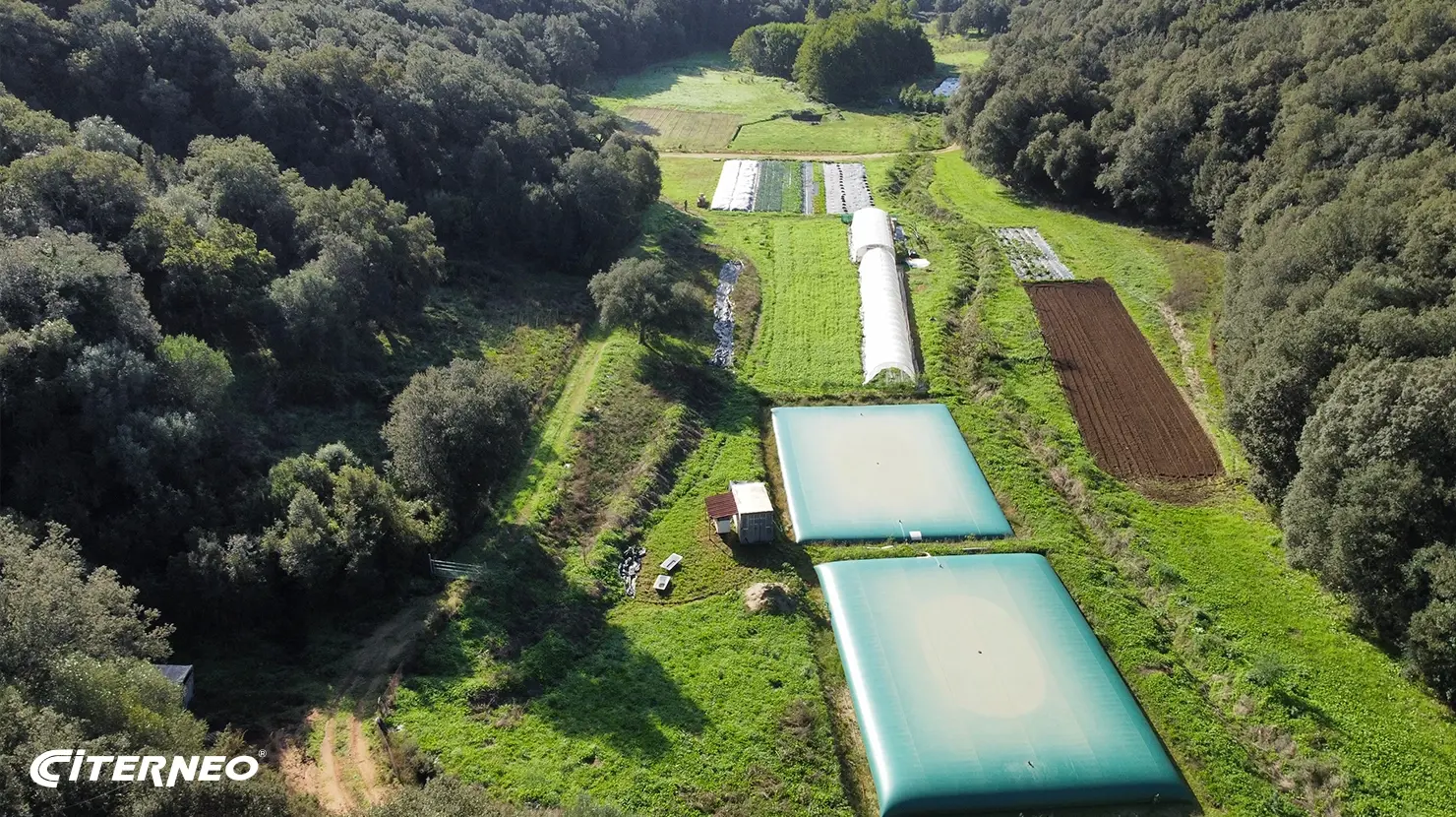
By choosing three tanks of varying capacities - two of 500 m³ and one of 300 m³ - from the Citerneo brand Swann also optimized adaptation to the uneven topography of his site. This strategic choice shows that a modular solution can meet environmental constraints while remaining economically viable.
Agricultural flexible tank: a gravity system for maximum efficiency"
This Corsican market gardener opted for an ingenious organization by exploiting the natural slope of his land. The smaller tank, installed high up, feeds the two larger tanks below. This gravity-fed system simplifies water distribution without the need for pumps, thus reducing energy costs and dependence on electrical infrastructure.
This arrangement works like a "hydraulic staircase": the water gradually descends towards the lower tanks while maintaining a constant flow rate and pressure. This configuration proves ingenious for watering greenhouses and open-field plots. It guarantees optimization of resources, avoiding pressure variations or supply interruptions.
Subsidies and logistics: key stages in successful water management
To finance its project, Swann benefited from a subsidy covering 60% of the tanks' pre-tax cost. This support, granted within the framework of aid for young farmers, lightened the initial investment. Obtaining this aid, however, required meticulous preparation, including a hydrological study and a technical dossier.
Delivering the tanks also presented a logistical challenge. Transported by boat to Ajaccio, they were then brought to site by Swann himself, due to the steep, narrow roads typical of the region. This step underlines the importance of rigorous planning for agricultural projects whose location is difficult to access.
Results: controlled, sustainable irrigation for optimized water resource management
Since the commissioning of these 3 tanks, the farm has operated autonomously. Filled in winter, the tanks ensure a sufficient supply to cover summer needs. This advance storage enables production to be maintained, even during the driest months.
The adoption of this irrigation system has also transformed day-to-day water management. Swann can now water his crops at any time, with a stable flow rate and constant pressure. This flexibility makes it easier to adapt to the specific needs of each plot, and reduces losses due to supply interruptions.
Feedback: personalized sales support and recommendations
The success of this project also rests on the sales management of Fleur Sauvonnet, representative of the Citerneo company that supplied the tanks. From the very first contact, she took the time to talk with Swann to understand his specific needs and refine the technical proposal. Her proactive approach enabled her to support the farmer throughout the process, from defining the volumes required to the final installation.
Her involvement was not limited to a simple commercial relationship. Taking advantage of a vacation in Corsica, Fleur decided to visit the farm and observe the installation of the tanks. This trip enabled her to gain a better understanding of the realities on the ground, but also to strengthen the bond of trust with her customer.
This commitment underlines the importance of tailor-made support to ensure the success of agricultural projects in demanding environments.
In addition, the use of spiral hoses for the connections proved more reliable than polyethylene models, which are susceptible to deformation.
These adjustments demonstrate the need to listen to and support each farmer as he considers and develops his project, with appropriate technical advice.
An inspiring model for sustainable agriculture
The example of Swann Franceschi illustrates a concrete solution to the challenges of water management in agricultural environments. Its approach combines innovation and adaptation to local constraints, while relying on public funding to reduce the financial burden. This type of project is part of a broader movement to modernize agriculture, in line with ecological and climatic imperatives.
Citerneo's flexible tanks, thanks to their modularity and ease of installation, appear to be a credible alternative for securing irrigation in drought-prone regions. In France, support schemes for young farmers continue to encourage this type of investment, underlining the importance of promoting resilient and sustainable agricultural practices.
Towards optimized management of water resources
This testimonial shows that with well-thought-out solutions and appropriate support, farmers can overcome the challenges posed by dwindling water resources. This installation, with its flexible tanks, embodies a replicable model for other plantations facing similar needs.
Conclusion
Climate change is increasing the pressure on farming systems. The installation of these three flexible tanks shows that it is possible to adopt more resilient and sustainable practices to thrive in demanding environments.