
In January 2025, the devastating wildfires in Los Angeles rekindled the debate on water resource management, a particularly hot topic in France after the fires of recent summers. While the idea of using seawater may seem attractive in a context where fresh water is becoming scarce, it raises major technical and ecological issues. Citerneo flexible tanks, designed for water storage and supply, offer a reliable and durable alternative, perfectly compliant with DECI (Défense Extérieure Contre l'Incendie) standards and adapted to DFCI (Défense des Forêts Contre les Incendies) requirements.
Why salt water poses a problem
Salt water, while effective in the short term for extinguishing fires, has significant disadvantages in the long term. Containing around 3.5% dissolved salts, mainly sodium chloride (NaCl), it gives rise to technical and environmental problems.
In the first instance, its use quickly brings flames under control, making it a valuable solution in emergency situations. However, repeated use exposes equipment such as tankers, pumps and hydrants to accelerated corrosion. Metallic materials, in particular, suffer premature wear and tear, increasing maintenance costs and reducing infrastructure durability.
In the longer term, the ecological impacts become a cause for concern. When sprayed onto soil or vegetation, saltwater alters soil chemistry, making it difficult for plants and trees to regrow. These alterations, sometimes irreversible, exacerbate the damage caused by fires and hinder the natural regeneration of ecosystems.
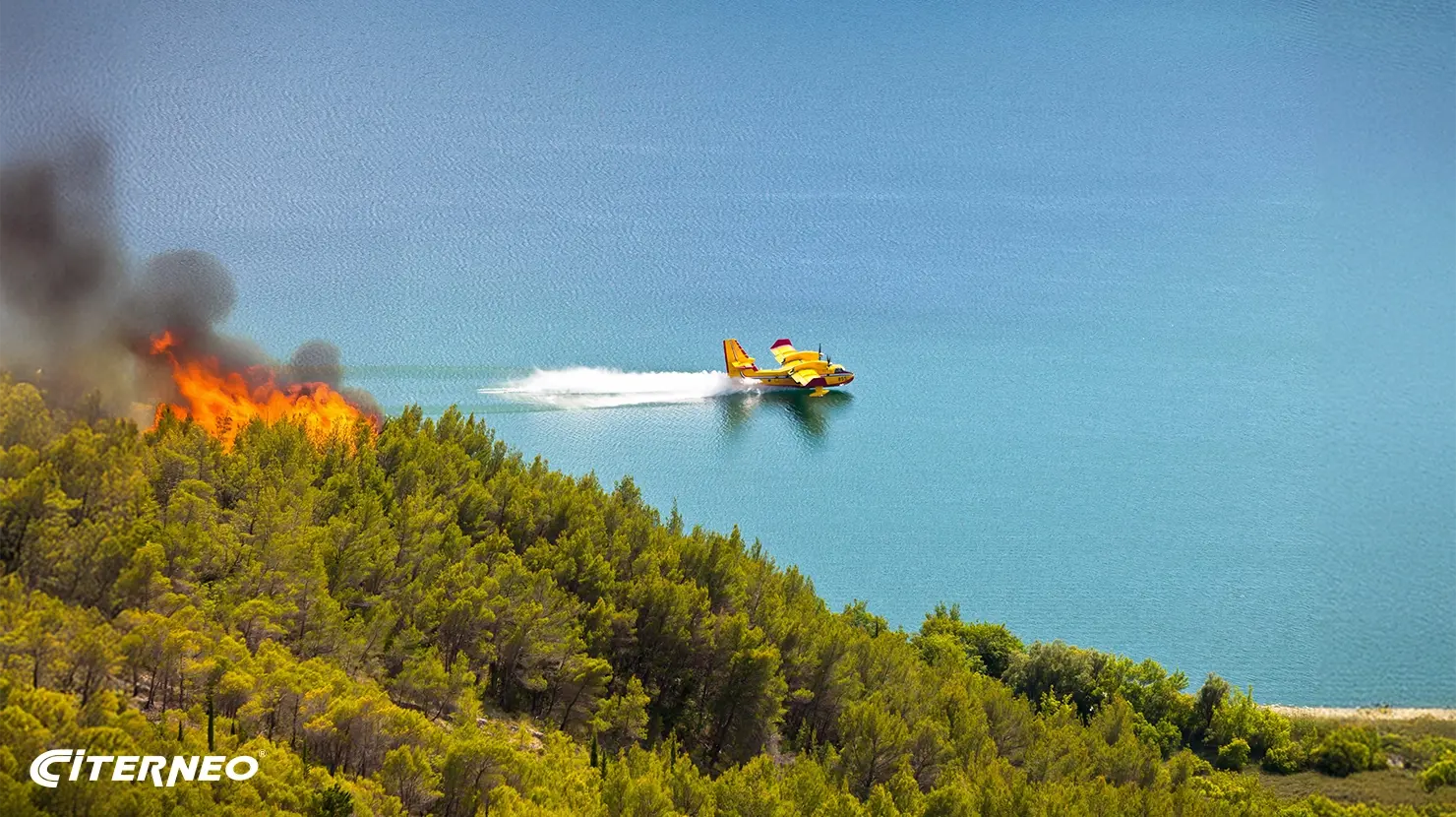
Although certain technical solutions can mitigate the effects of saltwater, its use remains tricky. For example, Canadairs, which often have to draw from marine water bodies, regularly have to deal with the corrosive effects of salt on their components. This illustrates the importance of favoring less corrosive and more sustainable water resources to protect both equipment and the environment.
Citerneo flexible tanks: the right solution
Faced with these challenges, Citerneo flexible tanks stand out for their technical features and efficiency. Designed to store water, including rainwater, they meet the needs of emergency services, particularly for rapidly supplying trucks on the ground.
Thanks to their sturdy, versatile design, Citerneo flexible tanks can be integrated into a variety of arrangements and meet both emergency situations and perennial needs:
Capacity and flexibility: Available in several sizes, they can store large volumes of water (up to 2,500 cubic meters) and adapt to the constraints of isolated or hard-to-reach areas.
Equipment protection: By preventing corrosion-related problems, they guarantee the durability of infrastructure used for firefighting.
EDCI and DFCI compliance: Citerneo tanks comply with regulatory requirements for external fire defense and are positioned as a benchmark for forest fire defense.
Simplicity of deployment:Easy to transport and install, they enable rapid intervention, essential in firefighting.
Water: a key resource
Flexible tanks also maximize the use of rainwater, a precious renewable resource. By capturing and storing this water, they reduce pressure on drinking water resources and enable strategic use for a variety of missions. In addition to fire-fighting, this water can be used for agricultural purposes, irrigation, watering or even road cleaning.
A sustainable and strategic solution
Recent fires are a reminder of the importance of reliable water management solutions. The use of salt water, while tempting in certain circumstances, remains a complex option to deploy on a large scale due to its technical and ecological drawbacks. In contrast, Citerneo flexible tanks offer a practical and environmentally-friendly solution. Thanks to their ability to store water in large quantities, they guarantee a rapid and effective response to fires while preserving ecosystems and equipment.
By choosing Citerneo flexible tanks, local authorities and professionals are assured of a compliant, high-performance and sustainable solution to meet the challenges of tomorrow.