
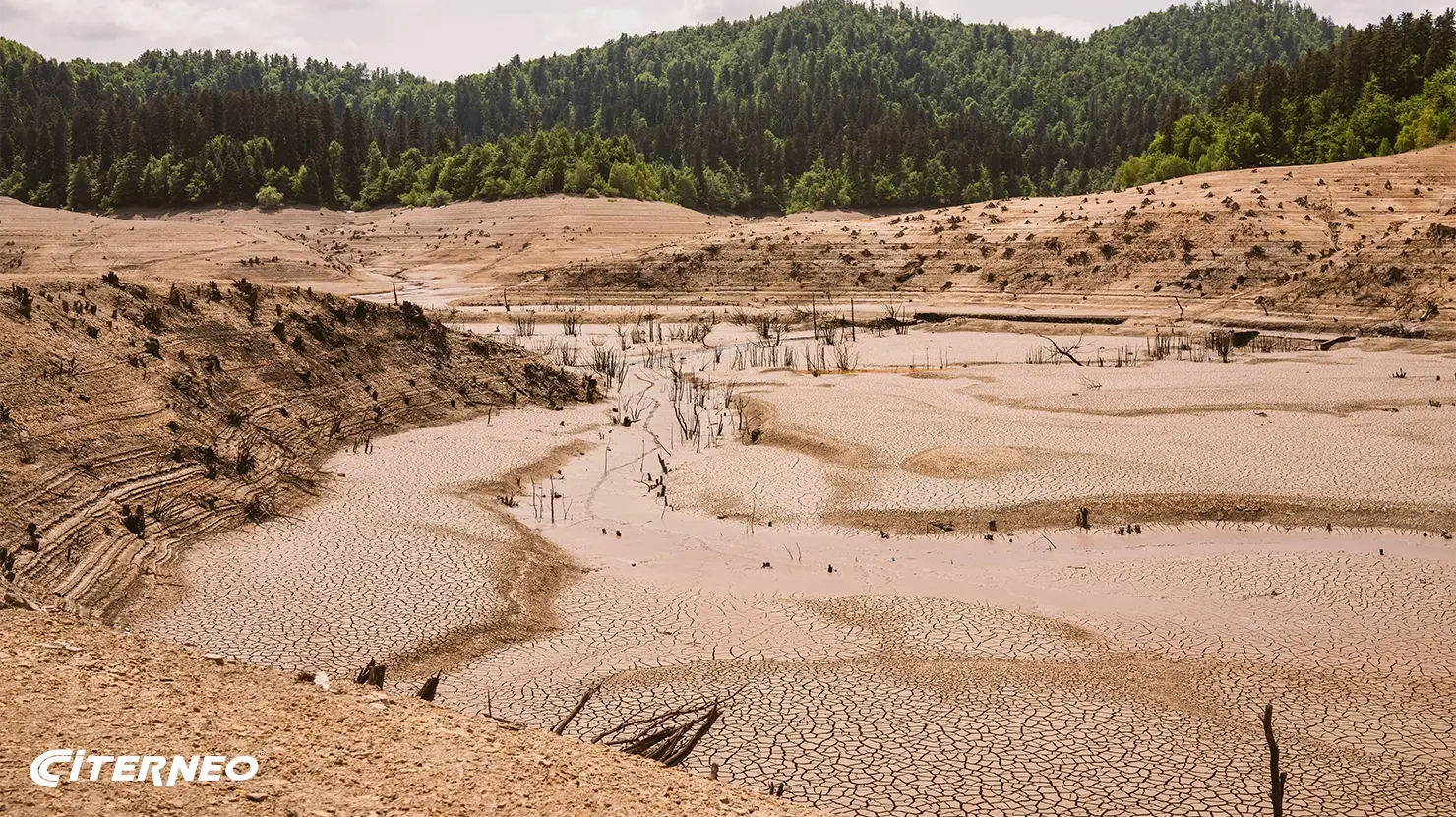
Access to drinking water is vital for climate change resilience. The climate crisis is often discussed in terms of carbon emissions, but the effects of climate change are felt most acutely in the area of water.
It is estimated that over the past decade, more than 90% of major disasters have been caused by floods, storms, heat waves, droughts and other meteorological phenomena.
Water scarcity: a major challenge of the 21st century
The water crisis is not just hitting the arid regions of the world; it is now intruding into Europe and, more specifically, France.
According to the European Water Information Centre, 25% of French water tables were showing historically low levels in 2021.
A concern made all the more acute by the fact that, according to the Agence Française pour la Biodiversité, more than half of the country's watercourses regularly experience periods of drought.
Metropolitan France, after experiencing a fourth heat wave at the beginning of August 2023, (the 4th in 2 months) is going through a drought unseen since the start of the measures introduced in 1958.July ranked as the second driest month since July 1959, with just 9.7 millimeters of precipitation, marking an 84% deficit compared with normal.
Faced by this lack of rain, several regions have instituted drought decrees in 62 départements this summer. (source Météo France)
This water deficit spares no region. Experts predict that by 2050, several areas, notably in Nouvelle-Aquitaine and Occitanie, could see their water availability fall by 10 to 30%.
These alarming figures are a wake-up call and make resolute action to preserve this vital resource imperative.
Yesterday abundant in so-called temperate zones, this resource has today become threatened.
As small rivers make great rivers, it is essential that at national and local level, initiatives are taken, not to mitigate the already palpable effects of climate change, but to adapt ourselves.
The potential of the flexible tank: between innovation and ecology
Faced with these challenges, water resilience has become a necessity.
It's our technical and collective capacity to retain the maximum of this resource that is now being put to the test.
It's scientifically proven that water tables don't take full advantage of violent and rapid rainfall. It's no longer in the air of the times to build giant water reserves of the dam or mega-basin type. (In Charente-Maritime, the Conseil d'Etat confirmed on February 3 the ban on filling five basins for agricultural use in the communes of La Laigne, Cramchaban and La Grève-sur-le-Mignon due to insufficient impact studies.
In January, the Bordeaux Administrative Court of Appeal also invalidated six other projects in six Charente-Maritime communes (Anais, Benon, Le Gué-d'Alleré, Saint-Médard-d'Aunis, Saint-Sauveur-d'Aunis and Saint-Xandre), deeming the volumes of water envisaged to be excessive.)
Agile, flexible systems are what are being sought today, in order to be able to optimize water management.
Among the tools that have proved their worth in recent years, we find flexible tanks.
Easy to transport and install, flexible tanks help to improve water collection before redistribution.
Deploying a network of flexible tanks in a territory hit by irregular or even rare rainfall helps to reassure a population that has always grown up and lived in the belief of unlimited and permanent access to water.
Faced with these challenges, water resilience has become a necessity.
Flexible tanks: a technology at the service of water autonomy
Flexible tanks stand out thanks to their technology, which combines simplicity and efficiency. They play a key role in the quest for water autonomy.
Advantages of flexible tanks:
Flexibility: their flexible design means they can be adapted to different volumes, depending on requirements.
Durability: made from high-quality technical textiles, these tanks are robust and weather-resistant, and offer excellent dimensional stability.
Ecology: by enabling rainwater to be collected, they help reduce dependence on drinking water networks, thus limiting the withdrawal of natural resources.
The potential of the flexible tank: between innovation and ecology
The Citerneo group, with over 15 years' experience in the sector, offers innovative solutions for water storage through the design and manufacture of flexible tanks.
These water tanks, manufactured in France at their Amboise plant near Tours, can store various types of liquid, from drinking water to hydrocarbons.
What makes these tanks particularly attractive and impactful is their exclusive EXOM+ technology, guaranteeing perfect storage and watertightness.
Both robust and flexible in design, the flexible tank appears as an agile response to this complex challenge.
Rainwater harvesting then takes on its full meaning. Rainfall, although becoming more erratic, represents an untapped source of fresh water. Every year, thousands of liters of water evaporate or run off unnecessarily. The flexible tank captures this treasure in mid-air.
How flexible tanks contribute to water autonomy?
At the heart of the quest for water autonomy, flexible tanks are emerging as essential tools for optimal water management.
In contrast to rigid tanks, flexible tanks optimize space. In urban areas, where every square meter is expensive, this feature proves invaluable, as the flexible tank offers rapid installation and ease of reuse, all without the need for heavy construction work or building permits....
These flexible tanks are distinguished by their ability to adapt to a variety of spatial constraints, enabling installation in both restricted spaces and larger areas.
The main role of the tank is to capture and store water, whether rainwater, drinking water or other types of liquid.
By harvesting rainwater, for example, these tanks not only reduce dependence on conventional water networks, but also reduce pressure on groundwater, which is often overexploited.
This stored water can then be used for a variety of purposes, such as irrigation, washing, or, after treatment, for human consumption.
Water autonomy: towards a renewed relationship with water
To become autonomous is to take back power. Water, far from being a matter of course, is becoming a precious commodity. Every flexible tank owner becomes a player in his or her own resilience.
The craze for these tanks goes beyond the simple ecological and environmental trend. Economic reality is taking hold. Expected increases in water rates, coupled with restrictions, could prompt many public authorities and industries to invest in self-supply solutions.
In addition to their practicality, flexible tanks also play a crucial environmental role. Indeed, by limiting runoff, they reduce soil erosion and contribute to groundwater recharge.
More than just a container, it symbolizes a paradigm shift in our relationship with water.
Conclusion
In a world faced with increasingly frequent water shortage crises, the flexible tanks manufactured in France by the Citerneo group are proving to be an innovative solution for promoting water autonomy and strengthening resilience.
Their versatility, cutting-edge technology and ability to meet a variety of needs make them a wise choice for communities and businesses concerned with ensuring a reliable, sustainable water supply.
Investing in flexible tanks means investing in a future where water is a precious resource to be protected and preserved.
Flexible tanks and water autonomy: how to foster resilience in the face of water shortage crises.