
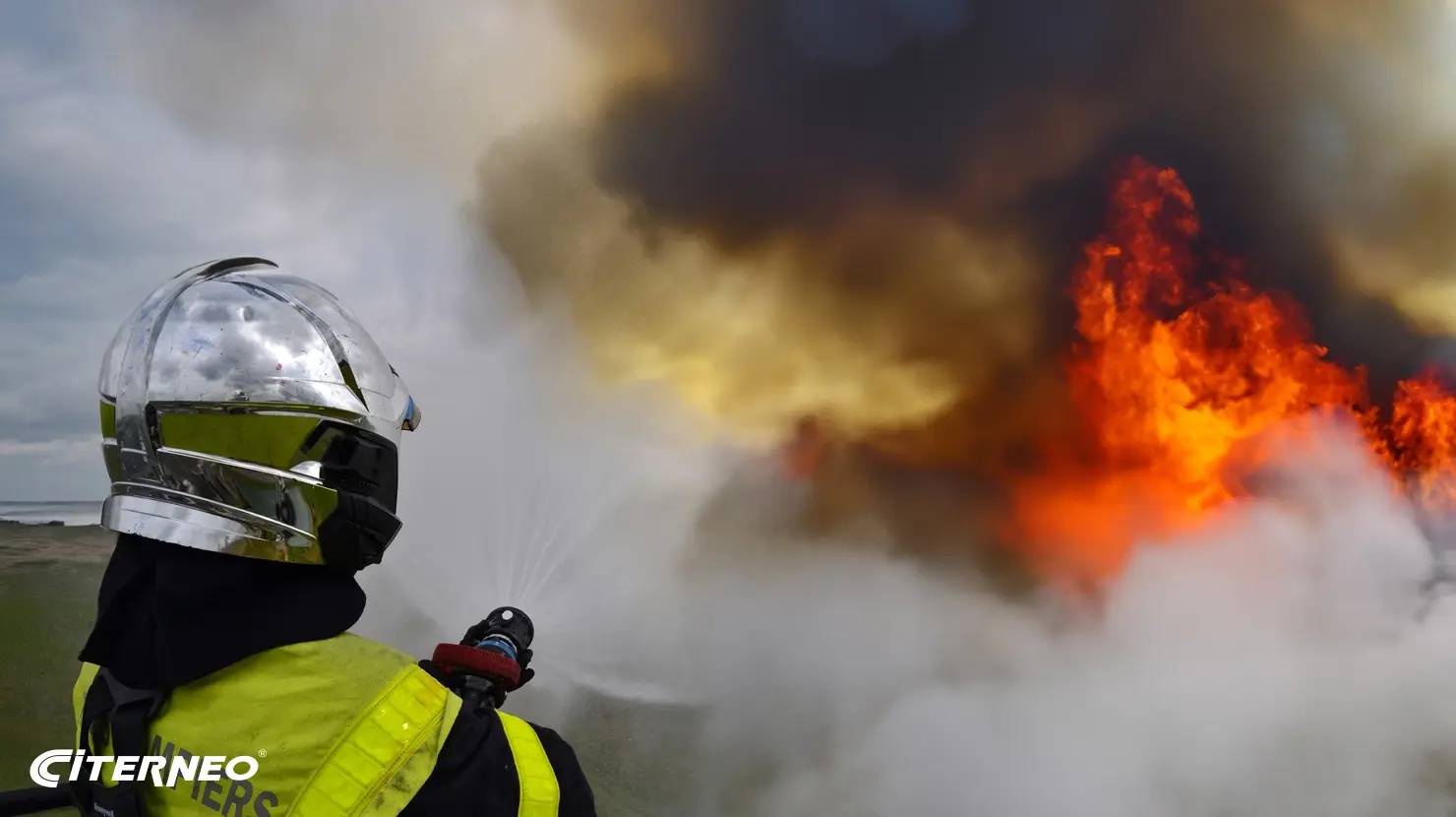
After a catastrophic summer of 2022 on the forest fire front - particularly in the South West, with 30,000 hectares going up in smoke in the Gironde department alone, the government has decided to step up its financial effort to enable firefighters to be better equipped in the field to fight fires.More water bombers, land vehicles, firefighters and military personnel have been assigned to the summer firefighting plan.
With 2 watchwords: anticipate and prevent to fight them.
How to effectively fight forest fires in 2023?
Nine additional water bomber aircraft and helicopters are being mobilized in 2023, raising the number of aircraft from 38 to 47.
The South West will also be the location of a future second civil security air base, after the one at Nîmes in the Gard.
Means for the SDIS to fight fires
An envelope of €180 million has been allocated to the departmental fire and rescue services (SDIS) to finance the purchase of 1,100 fire-fighting machines across metropolitan France.
Forest weather to inform on fire dangers
As it's always better to prevent than to "cure", the government has also created a "forest weather". This new tool takesthe form of a risk level for each département, on a four-level scale. Prevention messages will accompany the highest risk levels,"according to the Ministry of the Interior.
This "cartographic information is produced every day by Météo France at the end of the afternoon, from mid-May to the end of September, with a first map showing the risk level for the following day, and a second map for the day after," the government said.
The map "is distributed by Météo France on its digital media and is intended to be widely relayed by the media".
The prevention scheme "aims to treat any fire within 10 minutes of its detection during periods of high risk".
The creation of a green fund to support local authorities
The government points out that the Green Fund, endowed with 2 billion euros for 2023,"provides additional financial support for prevention policies and actions carried out by local authorities", focusing "essentially on improving the protection of territories located at the interface between wooded or vegetated massifs and built-up areas, where 80% of fires originate".
Measures thus enable "support for local authorities wishing to invest in systems to improve the effectiveness of legal brush clearance obligations"
On its website, the Ministry of the Interior, for its part, specifies that"from March to June, a communication campaign is dedicated to the legal obligations of brush clearance".
All approaches to constructions located"in or near forests (within a 200 m perimeter)"must be cleared of brush"over a distance of 50 m, regardless of property boundaries". The site adds that this distance can be extended to 100 m by municipal by-law. "Private access roads must also be cleared of brush on both sides for a width of 10 m."
The responsibility of communes in terms of fire reserves
As it is no longer possible to rely on natural water points supplied 365 days a year in order to mesh the territory, and knowing that the fire department does not possess unlimited means in terms of tanker trucks, the installation of flexible tanks certified DECI (Défense Extérieure Contre l'Incendie) is a solution adopted by many communes with the financial assistance of the Départements and/or Communities of communes.
Advantages of the flexible tank to help firefighters fight fire
The flexible tank has the advantage of being able to be stored almost anywhere.
It fills up during the months when rainfall is highest, and above all, it withstands high heat, one of the arguments that has the most impact with SDIS
When a fire breaks out, every minute counts. Firefighters have the ability to intervene very quickly at any point in the territory.
If they can capture water resources in a flexible tank in places that have neither fire hydrants nor natural water points (river, stream, lake, pond, ...), their battle against fire will be easier to win.
Tankers approved by SDIS, the French departmental fire and rescue services
CITERNEO flexible tankers, approved by the French departmental fire and rescue services (SDIS), are one of the solutions to this absolute need to reinforce the level of safety during periods of drought.
Fire tanks, the solution for firefighting
When the drinking water network is absent or inadequate for firefighting, communes, now responsible, must find other means to help firefighters fight potential fires quickly and effectively.
Fire hydrants, fire tanks, flexible fire tarpaulins... there's no shortage of solutions to meet sometimes tight budgets.
Flexible tanks help firefighters to fight fires
Flexible tanks offer a practical and suitable solution for storing and distributing water in emergencies, when the fire water network is non-existent or insufficient. They enable rural communes to boost their fire-fighting capacity, even with sometimes limited budgets.
Small communes are not alone in facing this civil security problem. Many départements have taken the measure of this challenge.
The Eure département equips itself with fire tanks
For example, the Eure département has decided to invest ten million euros from 2020 onwards to equip itself and help communes meet standards.
And for smaller communes, the Département de l'Eure has provided free flexible tanks.
The commune has taken on only the provision of a fenced plot, installation and maintenance of these 30 m³ or 70 m³ capacity tanks.
Since 2020, the Normandy local authority has financed 144 tanks as part of its emergency plan to help 363 communes invest in DECI (Défense Extérieure Contre l'Incendie).
Thousands of people living in the countryside are now better protected against the risk of fire thanks to these tanks.
Citerneo sets the example with its own fire tank
The Amboise-based company Citerneo is the leading manufacturer of flexible tanks in France and Europe. They have developed a flexible tank that complies with all regulatory fire standards.
These flexible fire tanks, also known as réserves souples incendie or réservoirs incendie are perfectly customizable and adaptable to the constraints and recommendations of France's SDIS.
To go even further in setting an example, this pioneering company has just installed its own 800 m³ fire tank on the site of its new plant.
Installed in line with SDIS expectations, this flexible tank completes the fire water network on the La Boitardière industrial estate and guarantees the safety of employees and property at Citerneo's new plant.
This tank is filled using rainwater collection.
It is equipped with compliant accessories and benefits from the latest innovations developed by Citerneo's R&D team :
Fire hydrants
Remote outlets
Direct valves
Weedkiller (this is an anti-vegetation tarpaulin to prevent weeding)
Securflow
It is made available to the Amboise Fire and Rescue Center to provide training for firefighters.
It is truly effective in fighting fires, especially in areas where access to water is limited or difficult.
For more information, you can contact the experts at Citerneo's design office.