
Faced with climate change and the upheaval of our ecosystems, water management has become a major issue for our future.
With September 2023 averaging 21.5°C, we've reached thermal highs since records began in France.
In early autumn, dry, hot weather has delayed groundwater recharge by spring 2024.
Anticipating and storing water is becoming a necessity, not only for individuals, but also for communities, industrialists and farmers.
Climate change affects growing water demands
According to the Food and Agriculture Organization of the United Nations (FAO), global water demand is set to increase by 50% by 2050.
Global water security under threat
Climate change is bringing changes to hydrological cycles, as evidenced by the frequency and intensity of floods and droughts.
Water security is confronted on the one hand by growing demand, and on the other, by a rapidly increasing global population.
The multiplication of extreme climatic episodes and the fragmentation of the resource generate a risk of shortages that varies according to geography.
Certainly, the volume of water that currently occupies 72% of our
planet's surface does not vary, but demographic and climatic evolutions mean that fresh water must be available for all living beings (water whose salinity is low enough to be consumed).
France facing numerous droughts
In France, the context is just as worrying. Summers are getting hotter and drier, and we've seen severe droughts in recent years, having a direct impact on water tables.
According to Météo France, 2022 was the driest year in almost 30 years. These trends, combined with population influxes during tourist seasons, are leading to increased pressure on our water resources.
The situation, which has been ongoing since March 2022, could worsen in 2024. Indeed, many French regions are reporting abnormally low groundwater levels, and earlier and earlier in the year.
Will storms at the end of October 2023 allow water tables to refill
In contrast, the end of October 2023 was marked by very intense storms, leading to flooding in many parts of the North West. Ciaran, Céline, Domingos.... Storms battered the Atlantic coastline.
These extreme events, exacerbated by climate change, highlight the vulnerability of our infrastructures to nature.
As a result, the question remains: will this bad weather allow the water tables to fill up?
According to Plein Champ, which is a site aimed primarily at farmers and their community: "we end this month of October 2023 with a surplus of 28%. Quite simply, this means that with 122 mm of rainfall aggregated over France, between October 16 and 31, we experienced the wettest period of any month, along with that from September 21 to October 5, 1993, just 30 years ago!"
We're going to have to wait a while before all this moisture seeps into the water tables.
Normally, rainwater seeps slowly into the ground, joining the underground water tables that supply a significant proportion of our drinking water. However, when soils are made impermeable by urbanization or when they are already saturated, this water cannot infiltrate properly.
It then runs off at the surface, causing flooding, erosion and major property damage, instead of helping to recharge these underground reserves.
This highlights the importance of designing cities with permeable surfaces and preserving natural spaces that facilitate the infiltration of water, an increasingly precious resource today.
Water table recharge still on hold
The Bureau de Recherche Géologique et Minière (BRGM) is awaiting new data for October 2023, but the latest readings leave little room for doubt.
Decreasing precipitation with a proven risk of water shortages
The BRGM forecast for northern France is slightly more optimistic, thanks to summer precipitation that stimulated partial groundwater recharge. However, the south of the country continues to show groundwater loss, exacerbated by the lack of precipitation.
The BRGM, referring to Météo-France anticipations, forecasts above-normal temperatures for the coming months, with little precipitation in the south of the country.
Faced with this situation, what can be done to avoid drying up the water tables?
Water consumption impacting the water tables
Water consumption has increased by 20% in France over the last two decades, reflecting a global trend. Forecasts for the spring of 2024 point to more intense periods of drought, making access to water even more complex.
As of October 1, 2023, almost 66% of water tables still had below-normal levels.
A figure that is steadily falling compared with the end of August, when 62% were below the normal threshold, according to the report by the Bureau de Recherches Géologiques et Minières (BRGM).
September's stormy rainfall did not significantly contribute to the regeneration of the water tables, hence this deterioration.
Furthermore, 18% of the sites observed by BRGM show particularly low levels.
What solutions are proposed to individuals to act in the face of this foreseeable water shortage ?
With current weather conditions forecasting a delay in groundwater recharge until the spring of 2024, it is becoming essential to consider alternatives for storing water on the surface to avoid placing excessive demands on groundwater.
Reducing water consumption by private individuals
For private individuals, this means finding solutions to limit watering the garden, filling swimming pools or even using water for showers or washing up.
It's recommended to use water-saving appliances such as dual-flush toilets or energy-saving showerheads.
Collect rainwater and store it for later use
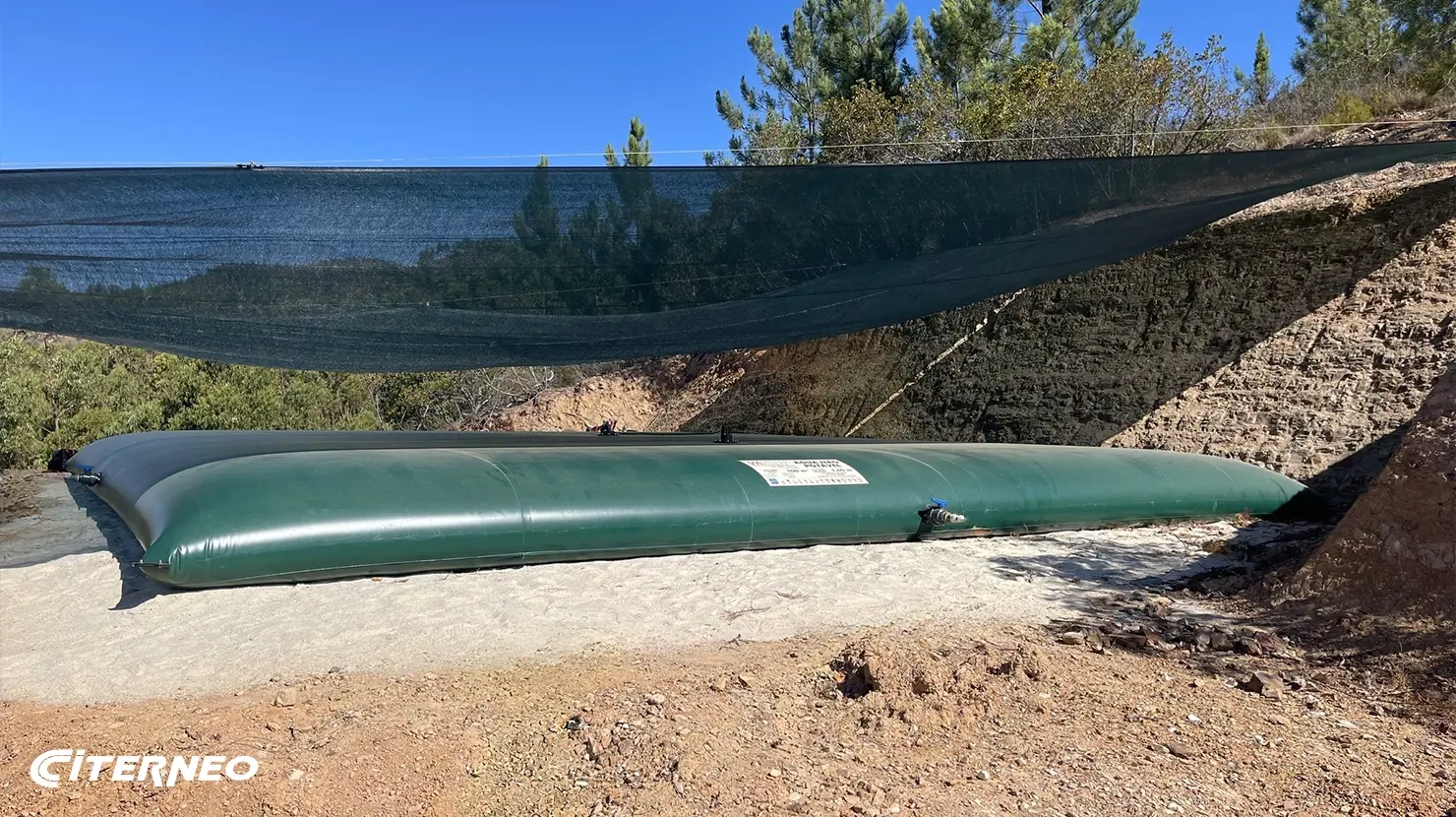
Adapted to all needs, flexible cisterns offer an innovative, ecological and sustainable water storage solution. Compared with other means of storage, they stand out for their ease of installation, strength and ability to adapt to any type of terrain.
They become particularly useful and vital when used to fight forest fires.
The testimony of a resident of Cogolin in the Var, recalls that following the fire in the Var on August 16, 2021, it was his two 30 and 40 m³ flexible tanks from the manufacturer Citerneo that saved his house and land.
This fire had completely disfigured the Maures massif and ravaged an area of 6977 hectares, causing the death of two people.
How do you cope with this water shortage when you're a local authority?
Communities, for their part, are also on the front line.
Towns are responsible for providing water to their fellow citizens, keeping green spaces healthy and supporting local industries.
A water shortage could not only make these tasks difficult, but also harm residents' quality of life.
Planning for water needs
Proactive planning and implementation can help mitigate the impacts of a shortage and ensure a sustainable water supply for all.
Planning is possible by educating and raising awareness among the general public on ways to reduce their daily consumption.
Some communities are developing shortage contingency plans, including rationing procedures, bottled water distribution, and other emergency measures.
Treat wastewater
By investing in infrastructure to treat and recycle wastewater, local authorities and communities of communes can reuse this treated water for irrigation or other non-potable uses.
Influencing water pricing and regulation
By introducing water pricing that increases with consumption, communes can encourage more parsimonious water use.
Also reflecting on regulatory developments, public authorities can also introduce strict rules on groundwater pumping and river detour.
Encourage innovative initiatives
Local authorities have the opportunity to encourage research into innovative technologies for desalination, water storage, and groundwater recharge.
In synergy with watersheds, they can create wetlands and retention basins to facilitate the infiltration of surface water into groundwater.
Some even envisage transporting water from a surplus region to a deficit region.
How can farmers anticipate this predicted water shortage?
Agriculture is the human activity that requires the largest quantities of water. Irrigation is the main source of water use. Corn, for example, accounts for 40% of irrigated land. In addition to field crops, market gardening, vegetables and fruit are also grown.... Livestock farming is another water-intensive activity. In fact, in agriculture, water consumption varies according to crop and species.
Irrigating fields
Firstly, farmers can invest in more efficient irrigation systems, such as drip irrigation. These enable water to be used more wisely, with less water-hungry crops being planted.
Storing water in crops
One of the most common methods is the use of tanks or retention basins to collect and store rainwater. These tanks or flexible cisterns can be installed close to fields and designed to capture runoff water during rainfall. Once collected, the water can be stored and later used for irrigation when the need is greatest.
Some farming techniques also allow water to be stored in the soil. For example, farmers can use water conservation methods, such as minimum tillage or the use of mulch, to reduce evaporation of water from the soil. This maintains a water reserve in the soil, accessible to plants during dry periods.
Preserving soil quality
Selecting crops suited to conditions of low water availability, such as drought-resistant crops, can help save water and store this valuable resource efficiently in crops. Implementing sustainable land management practices preserves soil quality.
Awareness of water-related issues and cooperation with other players in the agricultural industry and local authorities remain essential to developing effective long-term adaptation strategies.
Conclusion
It must be acknowledged that concern for economy relating to water consumption has not been a priority concern in our country as in many others.
It is now a necessity for each and every one of us, personally and collectively, to become an effective player in reducing this consumption.
This is why anticipation, notably through water storage, is essential. By storing water during periods of abundance, we can ensure that we have sufficient reserves during dry periods.